Google Rolls Out Gemini 3.5 Flash: Quicker Code, Smarter Agents
Google's new AI model promises speed where it counts: coding and complex, multi-step agentic workflows.

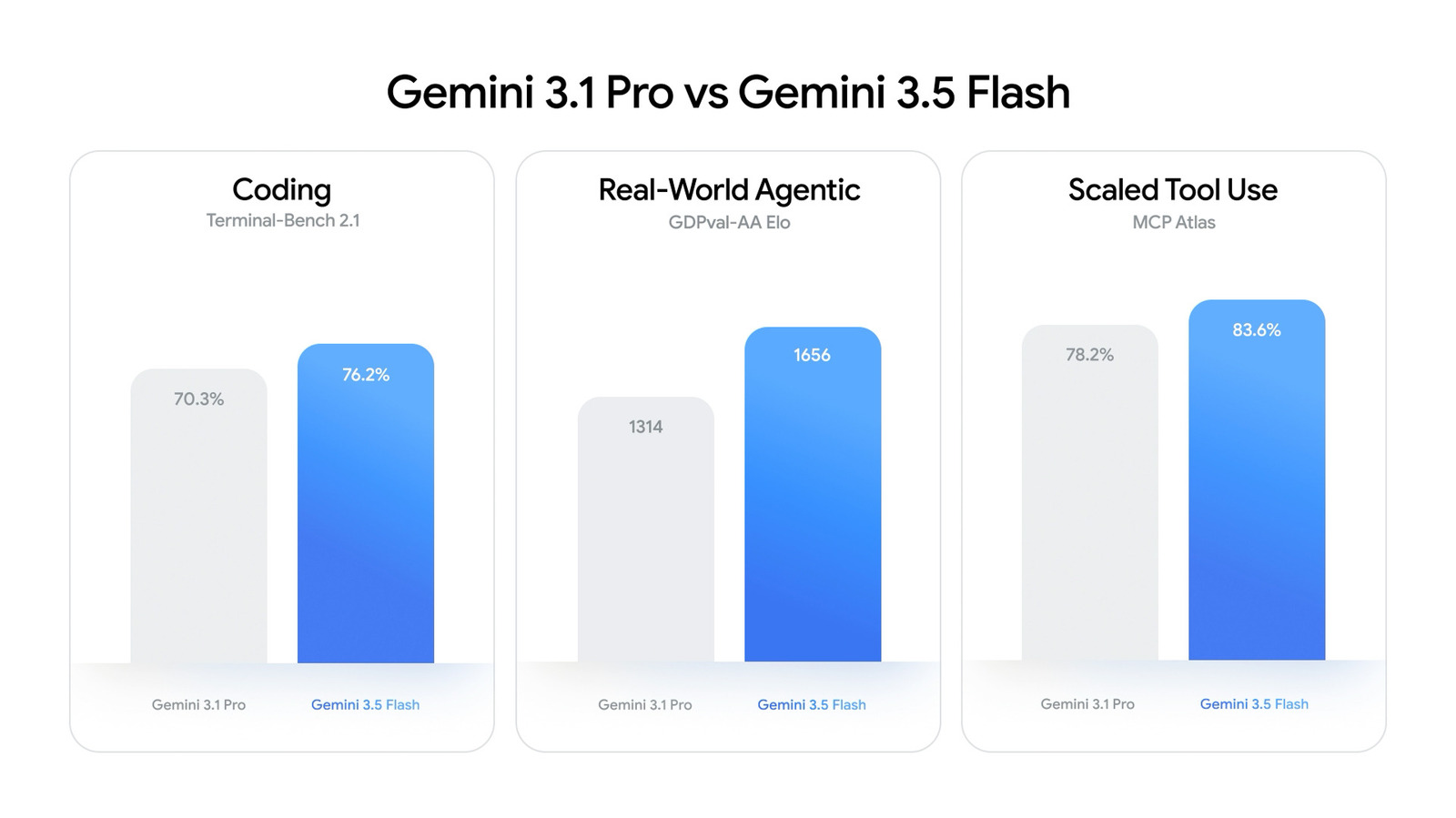
Google just dropped Gemini 3.5 Flash, an AI model that promises to revolutionize coding and complex 'agentic' tasks. Unveiled at Google I/O 2026, this new model is expected to significantly outperform its predecessor, Gemini 3.1 Pro, by delivering faster results without compromising on quality. Google's bold claim is that Gemini 3.5 Flash tackles tasks "in a fraction of the time" compared to other top-tier models, a statement that merits a closer look.
Breaking Down Gemini 3.5 Flash
Gemini 3.5 Flash represents Google's latest advancement in AI technology, positioned as a faster alternative to the existing Gemini Pro lineup. Despite being cheaper, it doesn’t quite match the deep reasoning or high-context understanding promised by the upcoming Gemini 3.5 Pro. Nevertheless, Google asserts that the performance gap has been significantly narrowed, with 3.5 Flash "delivering intelligence that rivals large flagship models on multiple dimensions." Such claims are indeed ambitious.
The model's true prowess is evident in its performance on various benchmarks. On Terminal-Bench 2.1, it scored an impressive 76.2%, while on MCP Atlas scaled tool use, it achieved 83.6%. It also scored 84.2% on CharXiv Reasoning. These benchmarks indicate a robust capability in handling complex tasks. Notably, the model’s output tokens-per-second are four times faster than other leading models, marking a significant leap in AI efficiency.
Applications and Availability
Gemini 3.5 Flash is tailored for 'long-horizon' agentic tasks, which encompass multi-week workflows that can now be completed in a fraction of the time. Its reliability in executing multi-step workflows and coding tasks, albeit with supervision, is being highlighted by Google. This makes it particularly appealing to sectors like banking and fintech that require the automation of complex processes. Early adopters in these industries are already leveraging its capabilities.
Access to Gemini 3.5 Flash is widely available through various platforms. Users can engage with it via Google Antigravity, the Gemini API in Google AI Studio and Android Studio, or the Gemini Enterprise Agent Platform. It's also integrated into the Gemini app and the AI Mode in Search, available globally. Additionally, Gemini Spark, a personal AI agent currently in testing, runs on 3.5 Flash.
Google emphasizes, "Under supervision, it can reliably execute multi-step workflows and coding tasks." This statement underscores their confidence in maintaining the model's high performance.
Enhanced Safeguards
With the release of Gemini 3.5, Google has ramped up its safeguards, addressing potential cyber and CBRN (chemical, biological, radiological, nuclear) threats. These enhanced protections aim to minimize the risk of the model generating harmful content while reducing the number of safe queries mistakenly flagged or rejected. This focus on safety is crucial as AI models become more integrated into sensitive and critical applications.
Context: The European Angle
In Europe, Gemini 3.5 Flash could become a crucial asset for industries that rely heavily on automated workflows and coding. Countries like Germany and the UK, known for their robust tech sectors, stand to benefit significantly. With AI adoption accelerating, European companies could leverage these new capabilities to maintain and enhance their competitive edge on the global stage.
What This Means for You
For developers and businesses, Gemini 3.5 Flash could dramatically accelerate project timelines, translating to both cost reductions and productivity gains. Those involved in coding or workflow automation should pay close attention to this model's development, as it may offer a competitive advantage in an increasingly AI-driven marketplace.
What's Still Unclear
Despite the promising capabilities of Gemini 3.5 Flash, several details remain unresolved. For example, the pricing for paid versions of the model has not been disclosed. Additionally, while the model is accessible to all through the Gemini app, specifics regarding the rollout of the Gemini 3.5 Pro model, expected next month, are still awaited. These unanswered questions highlight the need for potential users to stay informed as more information becomes available.
Why This Matters
The release of Gemini 3.5 Flash isn't just another update; it's a significant step forward in AI for coding and workflow automation. By pushing the boundaries of speed and efficiency, this model isn't merely participating in the race—it's setting a new pace for the entire industry. As AI technology continues to evolve, models like 3.5 Flash are not only transforming processes but also redefining the landscape of what's possible in AI applications.
Every leap forward in AI technology brings both opportunities and challenges. For businesses and developers, the key will be to harness these advancements effectively and responsibly, ensuring they stay ahead in a rapidly changing technological world. Whether you're directly involved in AI development or simply a stakeholder in an industry that could benefit from these innovations, staying informed and adaptable will be crucial to leveraging the full potential of models like Gemini 3.5 Flash.
Discuss this story
Got a take, a correction, or a follow-up tip? Reply where you read — we read everything.
Found an error? File a correction at /corrections. Substantive corrections are logged publicly.
One short email. The most important AI news, fact-checked, no fluff. Free, unsubscribe anytime.
More from AI
Perplexity Pro vs ChatGPT Plus: Which AI Assistant Fits Your Workflow?
This guide lays out the strengths and approaches of Perplexity Pro and ChatGPT Plus, helping you identify which AI assistant aligns with your specific needs.
Claude Pro vs Google Gemini Advanced: Which AI Assistant Deserves Your Subscription?
This definitive guide cuts through the marketing to give you a fair, balanced breakdown of Claude Pro and Gemini Advanced, letting you decide which AI best fits your workflow.
Claude Pro vs Google Gemini Advanced: Which AI Actually Earns Your Subscription?
Byte-Pulse lays out the real trade-offs between Claude Pro and Google Gemini Advanced, helping you pick the AI that fits your workflow, without picking for you.
ChatGPT Plus vs Google Gemini Advanced: Which AI Assistant Fits Your Workflow?
Deciding between ChatGPT Plus and Google Gemini Advanced? We break down the models, features, integrations, and pricing to help you align your choice with your specific priorities.
The Byte-Pulse Newsroom is the editorial system that produces Byte-Pulse's daily tech news coverage. Each story is cross-referenced across 3+ independent outlets, drafted with AI assistance by the newsroom system (Drafter → Editor → Fact-Checker → Polisher), and reviewed by Serhat Er, Editor-in-Chief, before publication. We disclose AI augmentation openly. Editorial accountability stays with the named editor on every article. Tips: editorial@byte-pulse.net.
Don’t miss these
Asus ROG Phone 9 vs Sony Xperia 1 VII: Which Niche Flagship Earns Your Money?
Deciding between the gaming-focused ROG Phone 9 and the creator-centric Xperia 1 VII? This guide breaks down every spec to help you choose.
Proton VPN vs NordVPN: Which One Earns Your Subscription?
A deep dive into Proton VPN and NordVPN, comparing their privacy, performance, features, and value, helping you make an informed decision.

Pokémon TCG Movie Signals Strategic Media Pivot for The Pokémon Company
A new Pokémon movie focused on the TCG is coming in 2027, marking a strategic pivot for the franchise as it navigates massive global fan engagement and logistical challenges.

Apple's AI Pivot: Vision Pro Content Cut, Siri Rebuilt Amid Layoffs
Apple's latest layoffs signal a strategic pivot, dialing back high-cost Vision Pro content while re-tooling Siri for the AI era. What's next for Apple?

D23 2026: Disney's Content Deluge Sparks Questions About Strategy
Byte-Pulse cuts through D23 hype: We dissect Disney's ambitious content slate, from Simpsons: Hit & Run to Ahsoka season 2, and question the real-world implications and European market strategy.
Honor Magic 8 Pro vs Samsung Galaxy S26 Ultra: Which Future Flagship Fits Your Wallet and Workflow?
Deciding between the anticipated Honor Magic 8 Pro and Samsung Galaxy S26 Ultra? Our deep dive into expected specs and features provides the fair comparison you need.