Why the Honeywell Turbo-Ventilator is Your Go-To Fan for Summer Comfort
Discover the unique features, customer reviews, and pricing of Honeywell's latest offering.

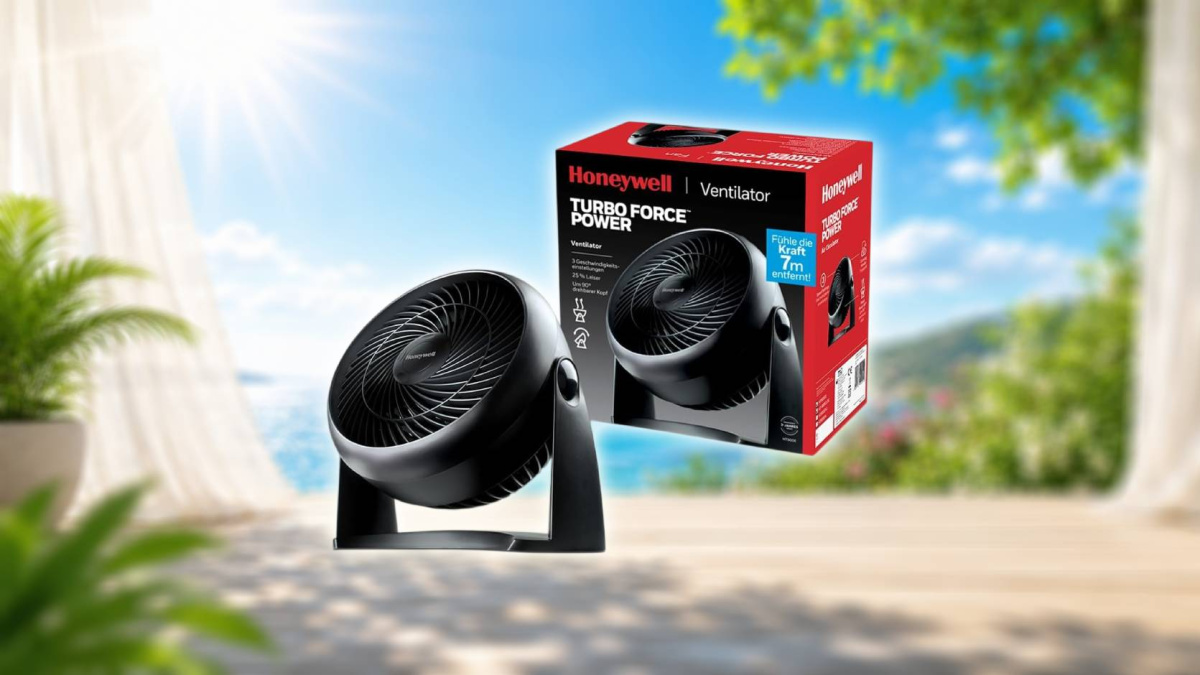
Why the Honeywell Turbo-Ventilator is a summer essential
As temperatures climb across Europe this summer, finding effective cooling solutions becomes a top priority for many households. The Honeywell Turbo-Ventilator, particularly the TurboForce Power model, stands out as a promising option. Priced attractively at around €22 on Amazon during early Prime Day promotions, this compact fan blends affordability with impressive functionality, making it a solid choice for a wide range of consumers. With heatwaves looming, having a reliable cooling device isn't merely a luxury—it's an absolute necessity.
The Turbo-Ventilator provides effective airflow and is conveniently portable. It seamlessly fits into various settings, be it a home office, bedroom, or even on a picnic or camping trip. According to Erik Körner from Golem, the device has a reach of up to seven meters and features adjustable speed settings, allowing users to customize their cooling experience. In a market saturated with bulky fans, this model distinguishes itself with its performance and sleek design.
Key features that set the Turbo-Ventilator apart
The Honeywell Turbo-Ventilator boasts several standout features. Its compact size—28.2 cm x 16.2 cm x 29.1 cm—ensures it can fit into smaller spaces without causing clutter. Users can select from three speed settings, ranging from a gentle breeze to a more robust gust. The 90-degree oscillating head ensures even air distribution, a feature often absent in similarly priced models.
Operating at what Honeywell claims is a low noise level, the Turbo-Ventilator is suitable for nighttime use or quiet settings. However, some customer reviews suggest it might not be as silent as the manufacturer advertises. Additionally, it can be mounted on a wall, adding versatility for those with limited floor space. These features contribute to making the Turbo-Ventilator a well-rounded cooling solution.
Compared to: The Honeywell Turbo-Ventilator vs. Dyson Cool AM06
When comparing the Honeywell Turbo-Ventilator to its competitors, the Dyson Cool AM06 often comes up as a point of reference. The Dyson model, priced at approximately €399, is significantly more expensive. It offers bladeless technology, which provides a unique and quiet airflow experience. However, at nearly 18 times the price of the Honeywell option, it might not justify the cost for everyone.
In terms of specifications, while the Dyson offers a more futuristic design and quieter operation, the Honeywell Turbo-Ventilator holds its own with effective cooling capabilities and essential features like oscillation and multiple speed settings. For budget-conscious individuals, the Honeywell model offers substantial savings while still delivering effective performance.
Real-life daily-use scenario
Imagine a typical summer day in a small European flat. The sun is blazing, and the temperatures are soaring beyond what one might comfortably tolerate. In such conditions, the Turbo-Ventilator becomes indispensable. Placed strategically in the living room, it circulates air efficiently, providing a refreshing respite from the heat. With its adjustable settings, you can switch from a powerful gust to a gentle breeze, depending on the time of day and personal preference.
Later in the evening, when it's time to wind down, the fan's portability allows it to be easily moved to the bedroom. Its compact size means it fits neatly on a bedside table without dominating the space. Even if noise levels are a concern, the gentle hum is generally not disruptive, lending itself to a peaceful night's sleep.
What this means for you
For anyone living in climates experiencing rising summer temperatures, the Honeywell Turbo-Ventilator offers a practical and cost-effective solution. Its affordability makes it accessible to a broad audience, while its functional features ensure it meets the cooling needs of most households. Whether you're looking to cool a small office space or need a versatile fan for outdoor activities, this model is equipped to handle a variety of situations.
Moreover, its compact design and wall-mounting capability mean it's suitable for apartments or homes with limited space. The ability to adjust speed settings and oscillation provides a customized cooling experience that can adapt to different preferences and environments.
What's still unclear
While the Turbo-Ventilator is generally well-received, a few uncertainties remain. The noise level, for example, is a point of contention. While Honeywell markets the fan as quiet, user reviews suggest there might be some discrepancies between expectations and reality. Additionally, long-term durability is something that hasn't been extensively documented. As with any product, user experiences can vary, and it's crucial to consider these factors when making a purchase.
Furthermore, the energy [efficiency](/article/enhancing-your-outdoor-space-with-eightree-s-smart-wlan-socket) of the Turbo-Ventilator compared to more expensive, energy-efficient models like the Dyson Cool AM06 remains unclear. With rising energy costs, understanding the potential impact on electricity bills is an important consideration for many consumers.
Closing take
The Honeywell Turbo-Ventilator is a worthy addition to any home in need of an effective and affordable cooling solution. Its combination of functionality, design, and price makes it an appealing choice in a crowded market. However, prospective buyers should be mindful of reviews regarding noise levels and consider their specific needs and expectations.
In the context of the European summer, where temperatures continue to rise, having a reliable and efficient fan like the Turbo-Ventilator can significantly enhance comfort and quality of life. By weighing the pros and cons, comparing it with other models, and considering alternative options, consumers can make an informed choice that best suits their cooling needs. As the summer heat approaches, investing in a dependable fan is not just about comfort—it's about readiness for the changing climate conditions.
Sources cross-referenced
This story was synthesised from reporting by 4 outlets:
Discuss this story
Got a take, a correction, or a follow-up tip? Reply where you read — we read everything.
Found an error? File a correction at /corrections. Substantive corrections are logged publicly.
One short email. The most important Hardware news, fact-checked, no fluff. Free, unsubscribe anytime.
More from Hardware

Apple M5 Pro vs. Apple M4 Pro: Projecting the Next Generation of Apple Silicon
We project the likely advancements of the unannounced M4 Pro and M5 Pro chips, offering a balanced, speculative look at future performance and efficiency.

AMD Ryzen 7 9800X3D vs Intel Core Ultra 7 265K: Which Chip Drives Your Next Build?
Deciding between AMD's V-Cache prowess and Intel's new Ultra architecture? This guide cuts through the noise to show you what each CPU truly offers for your money.

AMD Ryzen 9 9950X3D vs Intel Core Ultra 9 285K: Next-Gen Desktop Showdown
A deep dive into the expected strengths of AMD's Zen 5 X3D and Intel's next-gen Core Ultra K-series, laying out the trade-offs for serious buyers.

AMD RX 9080 XT vs. NVIDIA RTX 5080: Which High-End GPU Fits Your Build?
Navigating the high-end GPU market means weighing raw rasterization, ray tracing, upscaling tech, and ecosystem against your budget and priorities.
The Byte-Pulse Newsroom is the editorial system that produces Byte-Pulse's daily tech news coverage. Each story is cross-referenced across 3+ independent outlets, drafted with AI assistance by the newsroom system (Drafter → Editor → Fact-Checker → Polisher), and reviewed by Serhat Er, Editor-in-Chief, before publication. We disclose AI augmentation openly. Editorial accountability stays with the named editor on every article. Tips: editorial@byte-pulse.net.
Don’t miss these

Nothing Ear (3) vs AirPods 4 ANC: The Right Earbuds For Your Ears
We cut through the hype to compare the rumored Nothing Ear (3) and AirPods 4 ANC, laying out the real trade-offs so you can decide for yourself.

Notion vs Obsidian: Which Knowledge Hub Fits Your Workflow?
Deciding between Notion and Obsidian? We break down the core differences in philosophy, data ownership, collaboration, and extensibility to help you choose.

Lenovo Legion Go S vs. ASUS ROG Ally X: Which Next-Gen Handheld Earns a Spot in Your Backpack?
Deciding between the Legion Go S and ROG Ally X? We break down every spec, every design choice, and every trade-off without picking a winner. Your perfect gaming handheld is here.

Perplexity Pro vs ChatGPT Plus: Which AI Assistant Fits Your Workflow?
This guide lays out the strengths and approaches of Perplexity Pro and ChatGPT Plus, helping you identify which AI assistant aligns with your specific needs.

Sennheiser Momentum 4 Wireless vs Bose QuietComfort Ultra: Which Flagship Fits Your Daily Rhythm?
We lay out the real trade-offs between Sennheiser's long-distance runner and Bose's silence specialist, so your next premium audio choice is clear.

Proton VPN vs NordVPN: Which One Earns Your Subscription?
A deep dive into Proton VPN and NordVPN, comparing their privacy, performance, features, and value, helping you make an informed decision.