GTA 6's Realism Gamble: Will Player Patience Pay Off?
Rockstar's pivot to Red Dead-style depth in Grand Theft Auto 6 is a 'gigantic risk,' but one that might just redefine player engagement in the open-world genre.


Rockstar Games, a studio synonymous with sprawling open-world experiences, appears to be steering its much-anticipated Grand Theft Auto 6 into uncharted, and potentially awkward, territory. Early insights, pieced together from various official and leaked snippets since the game's initial reveal, paint a clear picture: this iteration of GTA is doubling down on a granular, Red Dead Redemption 2-esque realism, pushing the envelope even further than its Western predecessor. Forget the breezy, often brainless, plug-and-play action that defined previous GTA titles – the kind you might play half-blazed at 3 AM or simply on autopilot to unwind. GTA 6, it seems, is gunning for nothing less than a digital mirror of real life itself, and in doing so, might just become downright cumbersome for some.
The Mechanics of Mundanity: Deeper Systems, Deeper Questions
The details emerging about GTA 6's systems illustrate this commitment to verisimilitude. The venerable Wanted system, for instance, is no longer a simple matter of outrunning a minimap radius or a quick respray. Now, escaping the long arm of the law might necessitate a full disguise: changing your hairstyle, your outfit, even your vehicle, or, as Rockstar North co-studio head Rob Nelson told our peers at IGN, abandoning your car entirely to vanish into the game's intricate network of back alleys. This is a significant departure from the 'get a new paint job, problem solved' approach many of us grew up with, and frankly, it asks for a level of tactical engagement that previous titles rarely demanded.
Beyond just evading the police, your actions will seemingly carry persistent weight through a new Criminal Profile system. Your deeds, both commendable and cruel, will be recorded, influencing how NPCs react to you in the sprawling world of Leonida. This means no more consequence-free rocket-launching your way out of a bind, nor will a casual explosion of a petrol station full of cars go unnoticed. Furthermore, even your personal relationships within the game are subject to this hyper-realism; details as minute as holding a door open for your partner, Lucia, could impact the story's progression. Then there's the player's health and appearance, which will reportedly be influenced by diet, exercise, and hydration, promising a San Andreas-style system, but with an added layer of complexity that borders on digital self-care.
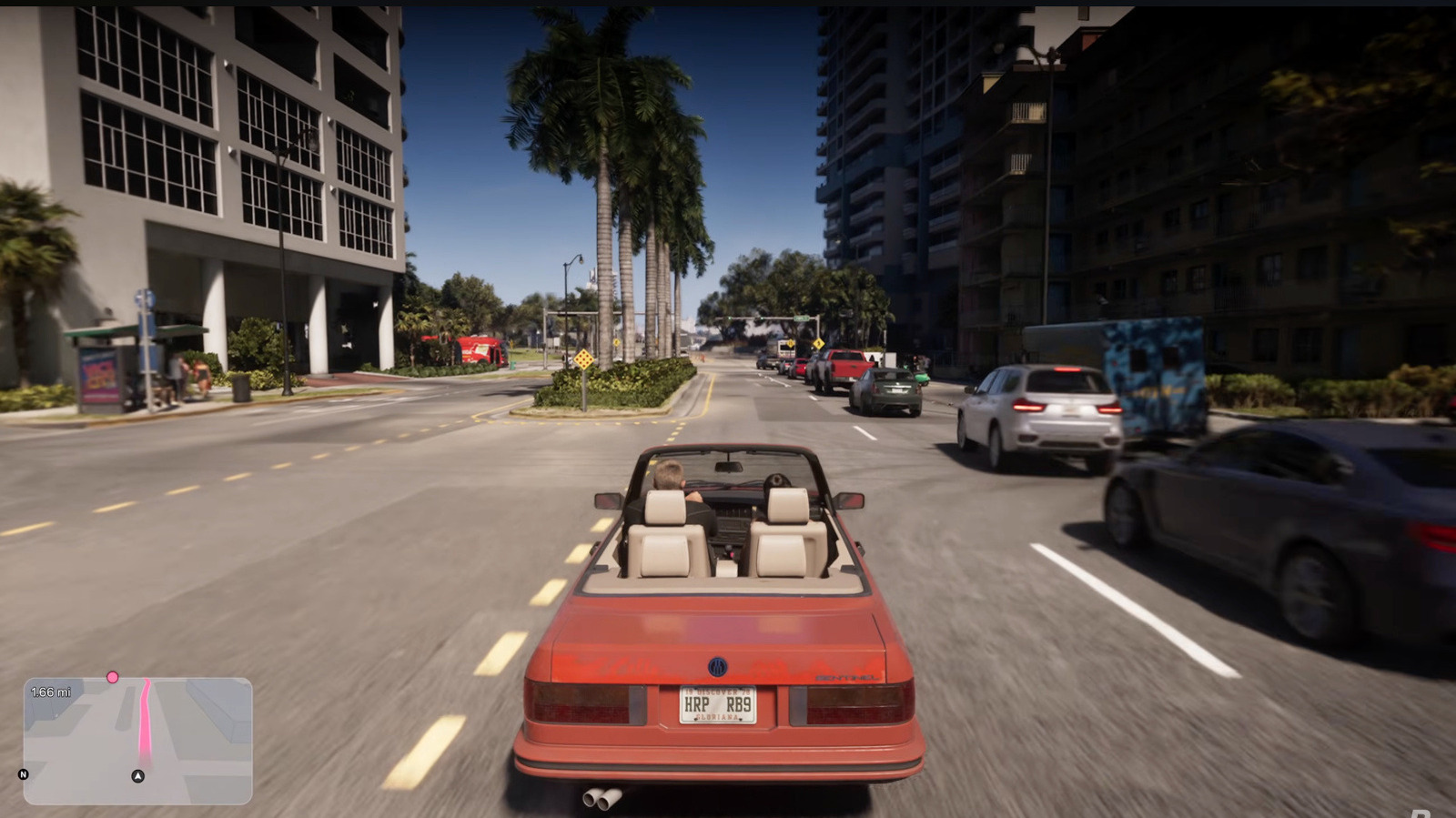
Perhaps the most striking example of this granular detail for us in the hardware and logistics world is the vehicle management. High-end cars, once ripe for the taking, will now feature security systems, requiring acquired skills to bypass, and come equipped with GPS trackers. You won't just 'yoink' a parked luxury car in the early game. And critically, there's the apparent need to refuel your vehicles. Anyone who's run European fulfillment for 12 years knows that managing fuel for a fleet is a constant, often tedious, logistical exercise. Translating that into a game, where the core fantasy is often unburdened freedom, is a bold move. Rob Nelson also highlighted that driving itself will be "more challenging" due to denser, narrower roads, mirroring real-world Miami and Florida, further complicating a system that was once gloriously simple.
The Byte-Pulse View: Ambition, or a Gamble on Friction?
The source calls this a "gigantic risk," and I'm inclined to agree, though perhaps not for the reasons most gamers might consider. From an operator's perspective, I see less a risk of failure for a studio with Rockstar's unparalleled resources and more a question of justification. Is this truly 'ambition' in the sense of pushing artistic boundaries, or is it a calculated move to differentiate a product in a market increasingly saturated with open-world titles that, frankly, often feel indistinguishable? The PR copy might call it revolutionary; I call it a substantial engineering and design investment that needs to prove its worth beyond novelty.
My opinion is this: while I appreciate the intent to inject more consequence and depth, Rockstar is treading a fine line between engaging realism and outright tedium. The promise of "friction" against the "uncanny smoothness of modern digital life" is alluring, especially to those of us who value a challenge. However, I'm skeptical that the average player, accustomed to GTA's historically immediate gratification, will embrace the minutiae of refuelling a car or meticulously managing their character's diet with the same enthusiasm they have for high-speed chases and explosive heists. This is a defensive move by Rockstar to secure its unique position, not necessarily a universally desired product strategy for the masses.
Lessons from the Supply Chain: Player Engagement as a Logistical Challenge
Think of player engagement like a supply chain. Every new system, every added layer of realism, is another node, another potential point of failure or bottleneck. In hardware logistics, if you introduce unnecessary steps, you increase costs and reduce efficiency. In a game, if you introduce tedious steps, you increase player frustration and reduce engagement. Serhat, our editor-in-chief, with his background in AR/VR and hardware logistics, often reminds us that shipping real things means understanding the practicalities of every link in the chain. For GTA 6, Rockstar is essentially adding dozens of new links to its gameplay chain, each requiring player input and attention.
This shift also raises questions about market reception, particularly in Europe. While German engineering often celebrates precision and depth, there's a practical limit to how much 'work' players are willing to put into a leisure activity. We've seen games like Death Stranding embrace mundane tasks, but that was a narrative-driven experience built around that very concept. GTA's audience has historically been broader, encompassing those who simply want to blow off steam. Will the European market, which has a strong appreciation for both deep simulation (think Euro Truck Simulator) and accessible action, embrace this hybrid? It's not a given, and the marketing and distribution strategy across EU territories will need to be carefully calibrated to manage expectations.
Beyond the Hype: What "Deep Mechanics" Really Mean for Development
The source correctly notes that 'ambitious' in video game writing often translates to "a big and expensive map with nice graphics." GTA 6's ambition, however, lies in its systems. But what does this really mean for the development studio? It means exponentially more QA cycles, more intricate balancing, and a significantly higher risk of emergent bugs within interconnected systems. Imagine the debugging nightmare when a player's relationship status, criminal profile, and current diet all conspire to create an unexpected narrative branch or a broken mission trigger. This isn't just about rendering better textures; it's about making a vast, complex simulation stable and enjoyable, a challenge that can bloat development timelines and budgets far beyond what a larger map alone would demand.
What's Still Unclear: The Unseen Costs of Verisimilitude
Despite the tantalizing details, a significant number of questions remain. How will the "Tamagotchi partner" relationship mechanics truly play out? Will the impact of holding a door open actually feel meaningful, or will it just be another chore on a checklist? The source mentions unspecified "stats" related to health and appearance; the devil, as always, will be in these details. Most critically, can Rockstar genuinely make the mundane tasks—like refuelling a car or picking through back alleys to escape the police—fun? The article itself admits this will be "very difficult." Without hands-on experience, it's impossible to gauge if this added friction will be a rewarding challenge or simply an annoyance that pulls players out of the core fantasy of being a criminal mastermind.
Why This Matters: Redefining the Open World for a New Decade
This move by Rockstar is a pivotal moment for the open-world genre. In an era where many games chase the lowest common denominator for mass appeal, GTA 6 is actively choosing to complicate its core loop. This matters because it challenges the industry's often risk-averse nature, pushing back against the "agonisingly, irrationally safe" decisions that have plagued many studios. If Rockstar can pull this off—if the awkwardness can be transformed into engaging depth—it could redefine what players expect from an open-world experience, shifting the focus from sheer scale to systemic richness. However, I maintain that this is less a universal blueprint for the industry and more a testament to Rockstar's unique position, allowing them to take such a significant commercial gamble. For the vast majority of studios, such a deep dive into realism without a proven track record would be not just a risk, but a financial impossibility. It's a fascinating experiment, and one we will be watching closely to see if the rewards truly outweigh the inherent friction for the player base.
Best-selling controllers, headsets and storage for your next session.
Shop gaming gear →Discuss this story
Got a take, a correction, or a follow-up tip? Reply where you read — we read everything.
Found an error? File a correction at /corrections. Substantive corrections are logged publicly.
One short email. The most important Gaming news, fact-checked, no fluff. Free, unsubscribe anytime.
More from Gaming

Pokémon TCG Movie Signals Strategic Media Pivot for The Pokémon Company
A new Pokémon movie focused on the TCG is coming in 2027, marking a strategic pivot for the franchise as it navigates massive global fan engagement and logistical challenges.

Rockstar's Netflix Gambit: A 'New Thing' or Calculated Content Gate?
Rockstar Games initiated the Netflix exclusive 'extended look' for GTA 6, drawing ire from fans. We dissect the strategy and its implications.
GTA VI: Beyond the Hype - Costs, Console Choices, and Cyber Threats
Byte-Pulse examines GTA VI's colossal scope, the practicalities of console choice, and the digital dangers lurking beneath the launch hype.

CD Projekt Red's 2028 Witcher 4 Target: Operational Strategy Over Release Date
Byte-Pulse examines CD Projekt Red's 2028 target for The Witcher 4, arguing the real story is the operational strategy behind a major Witcher 3 expansion.
The Byte-Pulse Newsroom is the editorial system that produces Byte-Pulse's daily tech news coverage. Each story is cross-referenced across 3+ independent outlets, drafted with AI assistance by the newsroom system (Drafter → Editor → Fact-Checker → Polisher), and reviewed by Serhat Er, Editor-in-Chief, before publication. We disclose AI augmentation openly. Editorial accountability stays with the named editor on every article. Tips: editorial@byte-pulse.net.
Don’t miss these
Lenovo Legion Pro 7i 2026 vs Razer Blade 16 2026: Which Flagship Gaming Laptop Fits Your Future?
Deciding between the next-gen Lenovo Legion Pro 7i and Razer Blade 16 means weighing peak performance against premium design and a more compact footprint. We break down the trade-offs.
Asus ROG Phone 9 vs Sony Xperia 1 VII: Which Niche Flagship Earns Your Money?
Deciding between the gaming-focused ROG Phone 9 and the creator-centric Xperia 1 VII? This guide breaks down every spec to help you choose.
Proton VPN vs NordVPN: Which One Earns Your Subscription?
A deep dive into Proton VPN and NordVPN, comparing their privacy, performance, features, and value, helping you make an informed decision.
Perplexity Pro vs ChatGPT Plus: Which AI Assistant Fits Your Workflow?
This guide lays out the strengths and approaches of Perplexity Pro and ChatGPT Plus, helping you identify which AI assistant aligns with your specific needs.
Razer Blade 16 (2026) vs ASUS ROG Zephyrus G16 (2026): Which Next-Gen Powerhouse Fits Your Workflow?
Deciding between Razer's premium Blade 16 2026 and ASUS's versatile ROG Zephyrus G16? We cut through the hype to lay out the real trade-offs.
Honor Magic 8 Pro vs Samsung Galaxy S26 Ultra: Which Future Flagship Fits Your Wallet and Workflow?
Deciding between the anticipated Honor Magic 8 Pro and Samsung Galaxy S26 Ultra? Our deep dive into expected specs and features provides the fair comparison you need.