PC Market Grows 2.5% in Q1 2026 Amid Supply Chain Challenges
Shipments rise 2.5% in Q1 2026 amid memory shortages, but challenges loom.

PC Market Grows 2.5% in Q1 2026 Amid Supply Chain Challenges
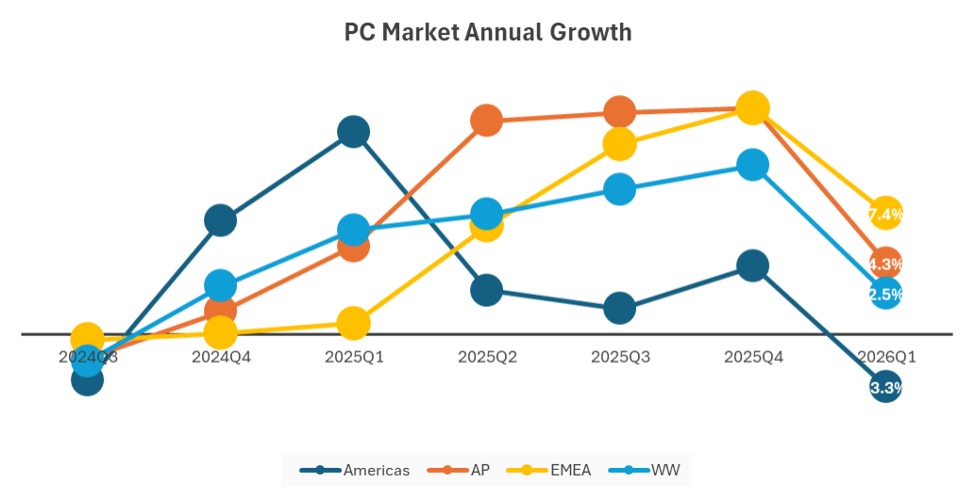
The global PC market has posted a growth of 2.5% in Q1 2026. According to the International Data Corporation (IDC), PC shipments reached 65.6 million units, an increase from the same period last year. This growth includes desktops, notebooks, and workstations while excluding tablets and x86 servers. Yet, a deeper analysis reveals a more complex narrative.
Challenges in the Supply Chain
Despite the positive growth figures, the PC industry faces significant supply chain disruptions, particularly concerning memory components. The challenging global economic environment compounds these issues. Companies that have secured a consistent supply of memory chips and diversified their product offerings are better positioned to address these challenges. Rising memory prices pose a substantial hurdle, likely impacting manufacturers and consumers alike.
Supply chain issues lead to cascading consequences. Increased component sourcing costs may force consumers to absorb these hikes. The current climate mirrors past disruptions, such as the transition from traditional desktop computing to mobile devices and the COVID-19 pandemic's impact on remote work and learning.
In Europe, the shift towards digital sovereignty and stricter regulations adds further complexity. These factors reflect an industry in constant flux, adapting to technological advancements and external economic pressures.
Market Dynamics and Influences
Several factors are driving current growth in the PC market. A primary motivator is the fear of further hardware price hikes, prompting consumers and businesses to purchase new systems sooner. Additionally, the transition from Windows 10 to newer operating systems encourages businesses to upgrade their hardware, boosting demand. New devices with advanced features also sustain consumer interest.
IDC's data indicates, though, that there is a slowdown in growth across many regions. If system prices continue to rise, IDC predicts a potential decline in shipments as the year progresses, underscoring the delicate balance between consumer demand and affordability.
Geopolitical Impact
Geopolitical tensions, particularly in the Middle East, exacerbate existing challenges. Disruptions in shipping routes between Asia and the EMEA region cause significant logistical headaches. Many companies have turned to air freight to expedite shipping, incurring substantially higher costs in the process. Rising energy and transport expenses are likely to push consumer prices higher, impacting the availability and affordability of new PCs.
These geopolitical tensions directly influence the supply chain, a critical factor often overlooked in discussions about market growth. The interconnectedness of global trade means that any disruption can ripple through to consumers, affecting purchasing decisions and dampening long-term demand.
Current Market Leaders
In this complex environment, certain companies have maintained or grown their market share:
- Lenovo: Leading with 16.5 million shipments, capturing a 25.2% market share, with an impressive growth of 8.6%.
- HP: Despite a decline, HP shipped 12.1 million units, holding an 18.5% market share.
- Dell: Secured a 15.7% market share with 10.3 million units, marking a 7.7% growth.
- Apple: Shipped 6.2 million units, commanding a 9.5% market share with a robust 9.1% growth.
- Asus: Achieved a remarkable 17.1% growth with 4.8 million units, translating to a 7.2% market share.
These figures highlight the competitive landscape where players strive to enhance their strengths amid industry-wide challenges. The resilience of certain brands can likely be attributed to their adaptability to supply chain issues.
Compared to: Past Trends and Competitors
Historically, the PC market has been sensitive to economic fluctuations and technological shifts. The current dynamics can be compared to the last major growth phase in 2021, when shipments surged due to pandemic-driven demand, reaching 79.5 million units and a 13% growth rate.
Key models from direct competition include: 1. Dell XPS 13 (2022 model): - CPU: Intel Core i7-12700H (12th Gen) - Memory: 16GB LPDDR5 - Price: €1,599 / $1,699 - Weight: 1.2 kg
2. Apple MacBook Air M2 (2022 model): - CPU: Apple M2 chip - Memory: 8GB Unified RAM (upgradable to 24GB) - Price: €1,199 / $1,199 - Weight: 1.24 kg
These models exemplify the premium segment where prices reflect both hardware and brand positioning. As current growth continues, understanding how pricing dynamics may shift amid intensifying competition and supply chain pressures is crucial.
What's Still Unclear
Despite growth, several uncertainties loom over the PC market:
- Will supply chain issues resolve soon? The timeline for stabilization remains uncertain as manufacturers work to mitigate disruptions.
- How will escalating geopolitical tensions impact the market? Potential disruptions in key shipping routes could lead to increased costs and delays.
- Can manufacturers sustain growth amidst rising costs? Balancing production costs with consumer affordability will be crucial.
Tracking these questions is vital for those involved in the tech industry, as answers could dictate market strategies and consumer behavior.
What This Means for You
For IT administrators and decision-makers, the current state of the PC market suggests cautious optimism and strategic planning. The modest growth indicates ongoing demand for new systems, but the threat of price increases means purchasing decisions should be approached carefully. Prioritizing upgrades for mission-critical systems may be wise before prices escalate.
Organizations dependent on a fleet of PCs should assess their hardware needs sooner rather than later. The prospect of rising prices could justify a bulk purchase strategy, especially for those looking to upgrade to newer operating systems requiring more robust hardware. However, for those who can afford to wait, stability in prices might allow for more strategic investments down the line.
Why This Matters
The resilience of the PC market amid challenges is commendable but underscores the need for strategic planning and adaptability. Current growth appears more defensive than a sign of robust health. Companies that swiftly adapt to ongoing supply chain issues will emerge stronger, while those that falter may struggle to meet rising consumer expectations.
As we move forward, monitoring evolving geopolitical and economic landscapes will be crucial for anyone in the tech industry. The interdependencies in the global supply chain mean that the actions of one player can reverberate across the entire market, emphasizing the need for resilience and foresight in planning.
Update — 2026-06-06
Since the article's publication, industry analysts have continued to monitor ongoing supply chain challenges that could impact the PC market's trajectory. Recent reports indicate that while growth in Q1 2026 was encouraging, manufacturers still grapple with component shortages, particularly in semiconductors. This situation has led to increased prices for consumers and potential delays in new product launches. As companies adjust their strategies to mitigate these issues, the long-term sustainability of this growth remains uncertain, highlighting the importance of resilience in the tech supply chain.
Discuss this story
Got a take, a correction, or a follow-up tip? Reply where you read — we read everything.
Found an error? File a correction at /corrections. Substantive corrections are logged publicly.
One short email. The most important Hardware news, fact-checked, no fluff. Free, unsubscribe anytime.
More from Hardware

Apple's AI Pivot: Vision Pro Content Cut, Siri Rebuilt Amid Layoffs
Apple's latest layoffs signal a strategic pivot, dialing back high-cost Vision Pro content while re-tooling Siri for the AI era. What's next for Apple?

Povasee A30 Jump Starter: A 50-Euro Deal With 5,000A Claims Under Scrutiny
The Povasee A30 jump-start power bank, on offer at Amazon for under 50 Euros, claims 5,000A peak current. We scrutinize this deal against real-world expectations.

Ugreen's 200W Charger: Powerhouse or Marketing Hype?
We analyze the Ugreen 200W charger's technical prowess, real-world utility, and the Amazon deal, highlighting its strengths and limitations

Victorinox Amazon Deals: Tactics or True Value?
Byte-Pulse examines Amazon's Victorinox deals, dissecting the true value of the Swiss Card Lite and Synergy X Alox against market trends.
The Byte-Pulse Newsroom is the editorial system that produces Byte-Pulse's daily tech news coverage. Each story is cross-referenced across 3+ independent outlets, drafted with AI assistance by the newsroom system (Drafter → Editor → Fact-Checker → Polisher), and reviewed by Serhat Er, Editor-in-Chief, before publication. We disclose AI augmentation openly. Editorial accountability stays with the named editor on every article. Tips: editorial@byte-pulse.net.
Don’t miss these
Proton VPN vs NordVPN: Which One Earns Your Subscription?
A deep dive into Proton VPN and NordVPN, comparing their privacy, performance, features, and value, helping you make an informed decision.
Perplexity Pro vs ChatGPT Plus: Which AI Assistant Fits Your Workflow?
This guide lays out the strengths and approaches of Perplexity Pro and ChatGPT Plus, helping you identify which AI assistant aligns with your specific needs.

Pokémon TCG Movie Signals Strategic Media Pivot for The Pokémon Company
A new Pokémon movie focused on the TCG is coming in 2027, marking a strategic pivot for the franchise as it navigates massive global fan engagement and logistical challenges.

Apple's 'Deep Discounts': US Inventory Flush, Not European Bargains
Byte-Pulse examines Apple's recent US sales, revealing that 'deep discounts' on popular devices like the iPhone 17 Pro and M3 iPad Air are less about consumer savings and more about clearing stock ahead of new launches. We critically assess whether these offers translate to real value for European buyers.

D23 2026: Disney's Content Deluge Sparks Questions About Strategy
Byte-Pulse cuts through D23 hype: We dissect Disney's ambitious content slate, from Simpsons: Hit & Run to Ahsoka season 2, and question the real-world implications and European market strategy.
Notion vs Obsidian: Which Knowledge Hub Fits Your Workflow?
Deciding between Notion and Obsidian? We break down the core differences in philosophy, data ownership, collaboration, and extensibility to help you choose.