Povasee A30 Jump Starter: A 50-Euro Deal With 5,000A Claims Under Scrutiny
Golem highlights an Amazon deal for a power bank promising 5,000A peak current for large engines. We contrast the price with its bold capabilities.

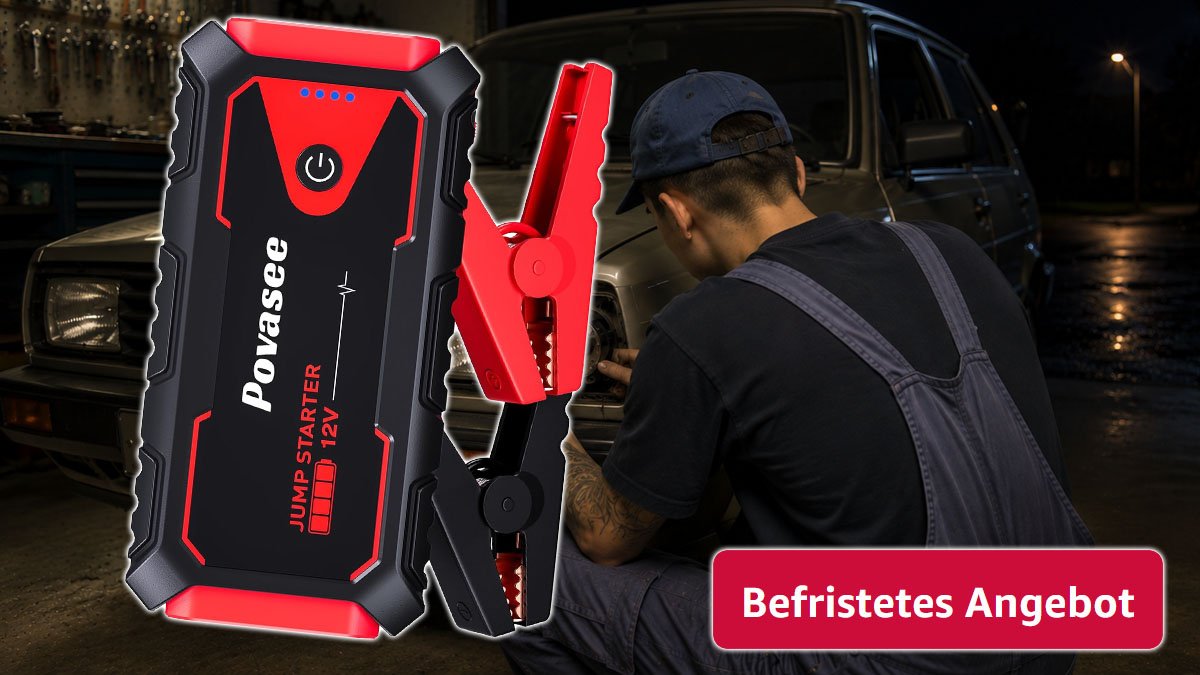
The digital landscape is awash with deal alerts, and German tech outlet Golem.de recently spotlighted a particular Amazon offering: the Povasee A30 jump-start power bank, currently available for a temporary discount. While such "Anzeige" (advertisement) pieces often present manufacturer claims at face value, our role at Byte-Pulse is to apply a critical, operator-centric lens. When a device promising significant power output drops below the 50-Euro mark, it immediately raises questions for anyone who has handled industrial-grade power solutions or managed vehicle fleets. This isn't about dismissing a bargain outright, but rather understanding what such a price point truly delivers in the complex world of power electronics.
The Povasee A30: A jump-start power bank for under 50 Euros
Golem.de, in its August 20, 2026, report, draws attention to the Povasee A30, noting its current Amazon price of 46.01 Euros. This is a significant markdown from its stated UVP of 69.99 Euros, and even below its 90-day average price of 54.50 Euros, according to price tracker Keepa cited by Golem. The article highlights the device's utility beyond traditional jump-start cables, emphasizing its portability and ability to revive a dead battery without a second vehicle. Golem also points out that the device has sold over 1,000 units in the last month on Amazon, achieving a solid 4.6 out of 5 stars from user reviews. While the convenience of a compact jump starter is undeniable, I'm immediately skeptical of the implied value proposition here; such a steep discount on a device with high-power claims often signals compromises that aren't immediately apparent in a deal listing.
Advertised power: 5,000A peak current for up to 10-liter gasoline engines
The core attraction of the Povasee A30, as emphasized by Golem.de, is its claimed ability to deliver a peak current of 5,000 Amperes. The manufacturer states this is sufficient for 12-volt vehicle systems, specifically targeting gasoline engines up to 10 liters and diesel engines up to 8 liters. These are formidable figures, suggesting compatibility with practically all passenger cars, numerous vans, and even some light commercial vehicles. For context, many reputable jump starters from established brands like NOCO or CTEK, designed for similar engine sizes, often retail for well over 100 or even 200 Euros, and their peak current ratings, while also needing scrutiny, typically align with a more premium price point. Golem.de itself cautiously notes that "highly set manufacturer specifications are no guarantee that every large engine can be started without problems under all conditions," citing factors like battery condition and ambient temperature. From an operator's perspective, anyone who has dealt with cold starts in a German winter knows that a 5,000A claim for a sub-50 Euro device warrants a healthy dose of skepticism. The internal resistance of the battery cells, the quality of the cabling, and the actual sustained current delivery are far more critical than a theoretical peak number, which can often be a fleeting, millisecond-long measurement.
The integrated battery capacity is listed by Povasee as 74 Wh, with a manufacturer claim of up to 60 start attempts per charge. While Golem.de rightly questions the consistency of this claim, the more practical concern is the device's ability to hold its charge over extended periods, especially when stored in an uncontrolled environment like a vehicle. Lithium-based batteries, particularly in high-discharge applications, are sensitive to temperature fluctuations, and their capacity can degrade significantly if left in a hot car for months or exposed to freezing temperatures. This isn't just a matter of convenience; it's a safety and reliability concern for a device intended for emergency use.
Beyond the jump: Dual USB ports and an integrated flashlight
Beyond its primary function, the Povasee A30 attempts to offer versatility, a common trend in modern power banks. Golem.de points out the inclusion of two USB outputs, allowing it to double as a conventional power bank for charging smartphones, tablets, or other mobile devices. The unit itself charges via USB-C, with a cable included, though a compatible power adapter is not part of the package – a detail typical of budget-friendly electronics. Additionally, an integrated LED light offers continuous, blink, and SOS modes, which can be genuinely useful during roadside emergencies, especially in low-light conditions. The device also boasts ten protection functions, including safeguards against short circuits, overcurrent, overvoltage, and overheating, specifically linked to its "intelligent jump-start cables." The housing is rated IP67, promising protection against dust and temporary submersion. While these additional features are certainly practical, they are not unique to the Povasee A30 and should not distract from the primary performance claims. The IP67 rating is a good baseline for a device intended for outdoor use, but the true test of robustness lies in the long-term durability of its connectors and internal components under real-world stresses, not just a lab test for water ingress.
User reviews suggest it meets its core function
The Golem.de article prominently features the Povasee A30's 4.6-star rating on Amazon, based on over 1,000 sales in the past month. This is a strong indicator of initial user satisfaction, suggesting that for many, the device performs its advertised jump-starting function adequately. However, as anyone familiar with online reviews knows, these ratings often reflect immediate gratification rather than long-term reliability or performance under extreme conditions. A quick start on a mildly drained battery in moderate weather is a different proposition than cranking a cold, high-displacement diesel in sub-zero temperatures with a deeply discharged battery. I find that relying solely on aggregate Amazon star ratings for a safety-critical, high-power device like this misses crucial nuances. Users rarely test the full extent of the 5,000A peak current or the 60-start claim, nor do they typically evaluate the device's battery degradation over multiple seasons. The positive reviews likely confirm that it can jump-start a typical car, which is a low bar for a device with such ambitious specifications.
What the deal price implies for the broader market
The sub-50 Euro price point for a jump-start power bank with these advertised specifications is what truly defines this deal, as Golem.de underscores. It positions the Povasee A30 firmly in the budget segment, making emergency power accessible to a wider audience. However, this accessibility comes with inherent trade-offs that consumers, particularly in Europe, should consider. The device is sold by "Povasee Direct," a Chinese merchant with a 100% positive rating, with Amazon handling the shipping. While Amazon's fulfillment is reliable, the long-term customer support, warranty claims, and adherence to specific European safety and environmental standards (like WEEE for battery disposal) from a manufacturer with a less established presence in the EU remain open questions. The market is flooded with similar budget devices, and while some offer surprising value, many fail to meet the rigorous demands of sustained high-current delivery or long-term battery integrity.
What's still unclear:
- Actual Peak Current [Verification](/article/spotify-s-new-tools-to-combat-ai-generated-music-clutter): Independent testing is needed to confirm if the 5,000A peak current is a sustained, usable output or a transient, theoretical maximum.
- Cold Weather Performance: How does the Povasee A30 perform at temperatures below freezing, a common scenario for jump-start needs in many parts of Europe?
- Battery Longevity and Cycle Life: What is the expected lifespan of the internal battery, especially considering its exposure to varied vehicle temperatures?
- EU [Certification](/article/blue-angel-expands-to-software-certification-for-sustainability) and Warranty: Beyond the general CE mark, what specific European safety standards (e.g., TÜV, GS) does it meet, and how robust is the warranty and after-sales support from a Chinese vendor?
- Charge Time: While USB-C charging is convenient, the actual time required to fully charge the 74 Wh battery is not specified.
Ultimately, the Povasee A30 at 46.01 Euros is an attractive proposition for those seeking an emergency jump starter without breaking the bank. But as with any deal that seems almost too good to be true, the devil is in the details, particularly when it comes to high-power devices where reliability is paramount. My take is that this device likely serves its purpose for occasional, non-extreme jump-starts, but anyone expecting the performance of a professional-grade unit for a fraction of the price might find themselves disappointed when it truly counts. It’s a classic case of balancing advertised specs against the practical realities of engineering and logistics, a balance that often shifts when the price dips below a certain threshold in the European market.
Sources cross-referenced
This story was synthesised from reporting by 4 outlets:
Discuss this story
Got a take, a correction, or a follow-up tip? Reply where you read — we read everything.
Found an error? File a correction at /corrections. Substantive corrections are logged publicly.
One short email. The most important Hardware news, fact-checked, no fluff. Free, unsubscribe anytime.
More from Hardware

Apple's AI Pivot: Vision Pro Content Cut, Siri Rebuilt Amid Layoffs
Apple's latest layoffs signal a strategic pivot, dialing back high-cost Vision Pro content while re-tooling Siri for the AI era. What's next for Apple?

Ugreen's 200W Charger: Powerhouse or Marketing Hype?
We analyze the Ugreen 200W charger's technical prowess, real-world utility, and the Amazon deal, highlighting its strengths and limitations

Victorinox Amazon Deals: Tactics or True Value?
Byte-Pulse examines Amazon's Victorinox deals, dissecting the true value of the Swiss Card Lite and Synergy X Alox against market trends.

Spider-Man's Inhibitor Tech: A Doomsday Device for the MCU
A look at Spider-Man: Brand New Day's inhibitor tech and its terrifying implications for Avengers: Doomsday, where Doctor Doom commands Sentinels.
The Byte-Pulse Newsroom is the editorial system that produces Byte-Pulse's daily tech news coverage. Each story is cross-referenced across 3+ independent outlets, drafted with AI assistance by the newsroom system (Drafter → Editor → Fact-Checker → Polisher), and reviewed by Serhat Er, Editor-in-Chief, before publication. We disclose AI augmentation openly. Editorial accountability stays with the named editor on every article. Tips: editorial@byte-pulse.net.
Don’t miss these
Asus ROG Phone 9 vs Sony Xperia 1 VII: Which Niche Flagship Earns Your Money?
Deciding between the gaming-focused ROG Phone 9 and the creator-centric Xperia 1 VII? This guide breaks down every spec to help you choose.
Proton VPN vs NordVPN: Which One Earns Your Subscription?
A deep dive into Proton VPN and NordVPN, comparing their privacy, performance, features, and value, helping you make an informed decision.
Perplexity Pro vs ChatGPT Plus: Which AI Assistant Fits Your Workflow?
This guide lays out the strengths and approaches of Perplexity Pro and ChatGPT Plus, helping you identify which AI assistant aligns with your specific needs.

Pokémon TCG Movie Signals Strategic Media Pivot for The Pokémon Company
A new Pokémon movie focused on the TCG is coming in 2027, marking a strategic pivot for the franchise as it navigates massive global fan engagement and logistical challenges.
Honor Magic 8 Pro vs Samsung Galaxy S26 Ultra: Which Future Flagship Fits Your Wallet and Workflow?
Deciding between the anticipated Honor Magic 8 Pro and Samsung Galaxy S26 Ultra? Our deep dive into expected specs and features provides the fair comparison you need.
Notion vs Obsidian: Which Knowledge Hub Fits Your Workflow?
Deciding between Notion and Obsidian? We break down the core differences in philosophy, data ownership, collaboration, and extensibility to help you choose.