Trump Pours Millions into Apple Ahead of China Trip
President's portfolio sees up to $7.2M Apple boost. Right before he heads to Beijing with Tim Cook.

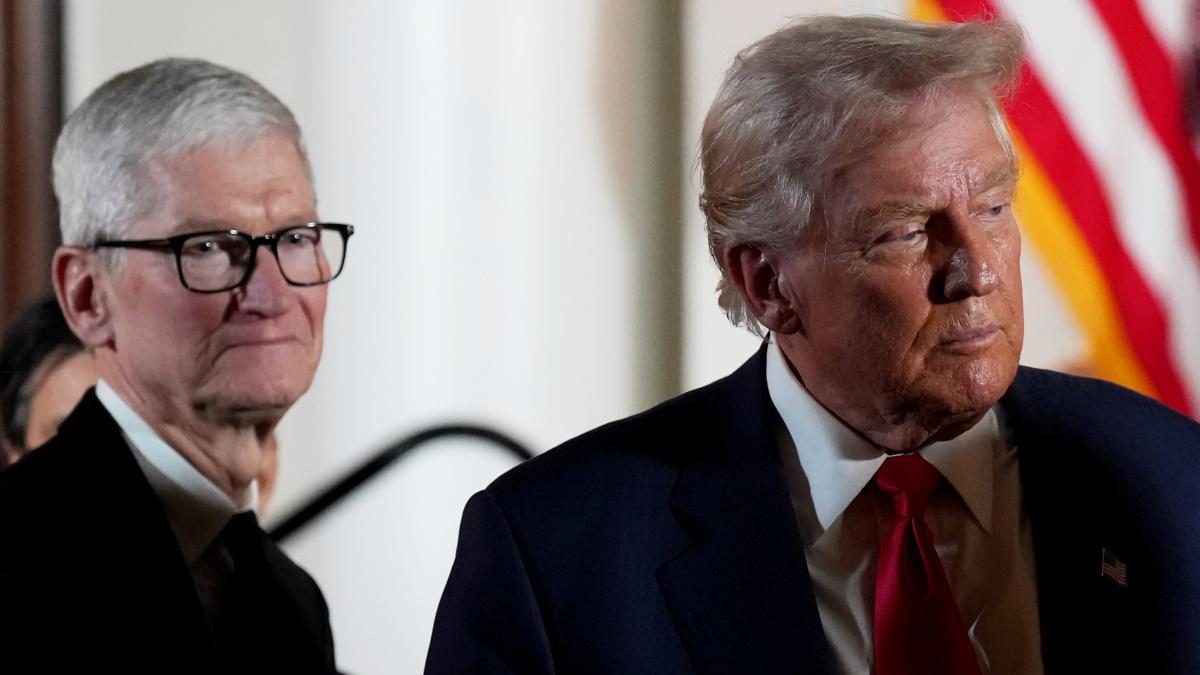
Trump's Millions in Apple Precede High-Stakes China Visit
President Donald Trump's financial portfolio saw a significant influx of capital directed towards Apple Inc. in early 2026, with reports indicating an investment totaling up to $7.2 million in the tech giant. This move comes just ahead of a crucial official visit to China, a trip where Apple's CEO, Tim Cook, is expected to accompany the President. The exact nature of these Apple investments—whether they were in stock, bonds, or other financial instruments—remains unspecified, a common ambiguity within government ethics disclosures which often provide broad categories rather than granular detail.
This financial maneuvering, detailed in a report by Golem, highlights the complex interplay between political actions and global technology markets. Trump's investment in Apple, a company heavily reliant on its manufacturing and sales operations in China, raises questions about potential conflicts of interest or strategic signaling ahead of sensitive trade negotiations. The proximity of these investments to a major diplomatic and economic engagement with China underscores the intricate web connecting political leadership, corporate interests, and international trade dynamics.
Tech Giants Caught in the Crossfire of Trade and Geopolitics
The recent financial disclosures reveal that Trump's portfolio wasn't solely focused on Apple. Significant transactions also involved other titans of American industry, notably Boeing and Nvidia, both of which have substantial business interests and face complex challenges in the Chinese market. Boeing, the aerospace behemoth, recently secured a substantial aircraft order from China valued at $37 billion. However, this deal, while large on its face, reportedly fell short of some analysts' expectations, leading to a dip in Boeing's stock performance. This suggests that even seemingly positive trade developments can be viewed through a lens of market anticipation and geopolitical undercurrents.
Nvidia, a leader in artificial intelligence chips, finds itself in a particularly precarious position. The company is actively seeking to navigate stringent U.S. export controls while simultaneously attempting to maintain its market presence in China. This dual pressure, stemming from both American regulatory policies aimed at limiting China's technological advancement and China's own drive for domestic tech self-sufficiency, presents a formidable obstacle. Nvidia's CEO, Jensen Huang, has publicly estimated that the company could face a revenue loss of as much as $50 billion this year due to these challenges. The stakes are undeniably high for companies like Nvidia, where access to the vast Chinese market is critical for continued growth and innovation.
These diverse financial and trade activities involving key American tech and aerospace firms illustrate the deeply entwined nature of politics and global commerce. The decisions made in Washington, D.C., whether through presidential investments or trade policy, can have immediate and far-reaching consequences for multinational corporations and the broader technological landscape.
A Quarter of Significant Financial Realignments
Looking at the broader scope of Trump's financial activities, the disclosures paint a picture of a remarkably active quarter. Approximately 2,300 transactions were logged within a three-month period, indicating a period of significant portfolio rebalancing. Notably, a substantial portion of these moves involved the divestment of technology stocks. Holdings in major companies such as Microsoft, Amazon, and Meta were sold off, with individual sales reportedly reaching up to $25 million each. This strategic selling of established tech giants, juxtaposed with new investments in companies like Apple, suggests a calculated, albeit opaque, approach to managing his assets amidst evolving market and geopolitical conditions.
The timing of these sales, occurring before the significant investment in Apple and the high-profile China trip, adds another layer of complexity. It raises questions about whether these divestments were a proactive measure to reduce exposure to potential regulatory scrutiny or market volatility associated with China-U.S. relations, or perhaps a reallocation of capital to specific areas perceived to be less exposed or more strategically aligned with upcoming political engagements.
Context: The Global Tech Landscape and EU Scrutiny
From a broader industry perspective, the actions of major U.S. tech players and their entanglements with China are under intense global scrutiny. This is particularly true in Europe, where the European Union has been actively pursuing its own agenda for digital sovereignty and regulatory oversight of Big Tech. The EU's tech sector, deeply integrated into global supply chains, is highly sensitive to U.S.-China trade tensions. Any significant shifts in trade policy or diplomatic relations between the two superpowers can send palpable ripples through European markets and strategic planning.
As the EU continues to champion initiatives like the Digital Markets Act (DMA) and the Digital Services Act (DSA), aiming to curb the power of dominant online platforms and foster a more competitive digital environment, the strategic moves of U.S. companies and political figures become even more consequential. Trump's investments, therefore, are not just domestic financial news; they are part of a larger global narrative about the future of technology, trade, and international power dynamics, a narrative that the EU is closely monitoring and actively shaping through its own regulatory frameworks.
What This Means for You
For the average consumer and investor, these developments carry tangible implications. If you hold shares in Apple, Boeing, Nvidia, or any of the other tech giants mentioned, you should be prepared for potential market volatility. Geopolitical events, especially those involving major economic powers like the U.S. and China, have an outsized impact on stock prices and market sentiment. The upcoming trip and any subsequent trade news or policy changes could influence the value of your investments. It's a reminder that global politics and corporate finance are deeply interconnected, and economic ripples from high-level discussions can eventually reach individual portfolios.
What's Still Unclear
Despite the disclosures and accompanying reports, several key questions remain unanswered, leaving a degree of ambiguity surrounding the full picture. Firstly, the precise nature of Trump's $7.2 million investment in Apple is not detailed; understanding whether it was a direct stock purchase, a derivative, or another financial product would offer more insight into the intent and risk profile of the transaction. Secondly, the direct impact and strategic intent of these financial moves on the upcoming U.S.-China trade talks are purely speculative at this point. It's unclear if this represents a personal financial hedge, a signal to Beijing, or simply a coincidental portfolio adjustment. Finally, the long-term ramifications for tech stocks, particularly those with significant exposure to China, remain uncertain, especially given the ongoing geopolitical complexities and the potential for further policy shifts from both the U.S. and China.
Editorial Take
President Trump's significant investment in Apple just before a high-stakes trip to China, alongside other strategic financial moves, underscores the intricate dance between personal finance, corporate interests, and international diplomacy. This situation serves as a potent illustration of how political power and global markets are increasingly intertwined, with decisions made at the highest levels capable of influencing both corporate fortunes and individual economic well-being.
Editor-tracked discounts on the gadgets and gear worth buying right now.
See the deals →Discuss this story
Got a take, a correction, or a follow-up tip? Reply where you read — we read everything.
Found an error? File a correction at /corrections. Substantive corrections are logged publicly.
One short email. The most important Web & Apps news, fact-checked, no fluff. Free, unsubscribe anytime.
More from Web & Apps

D23 2026: Disney's Content Deluge Sparks Questions About Strategy
Byte-Pulse cuts through D23 hype: We dissect Disney's ambitious content slate, from Simpsons: Hit & Run to Ahsoka season 2, and question the real-world implications and European market strategy.

Spotify Relaunches AI Running Mode for iOS Premium Users
Spotify's new Running Mode for iOS uses AI to sync music with your stride, but its success hinges on AI quality and user input

WhatsApp Web Gets Calls: Meta's Cross-Platform Play Begins
WhatsApp Web now supports encrypted calls, screen sharing, and call transfers. We dissect Meta's strategic shift and its implications for users and enterprise adoption in Europe.

Fox's $22 Billion Acquisition of Roku: A New Era in Streaming
Fox's acquisition of Roku for $22 billion marks a pivotal shift in streaming, merging content strength with platform reach.
The Byte-Pulse Newsroom is the editorial system that produces Byte-Pulse's daily tech news coverage. Each story is cross-referenced across 3+ independent outlets, drafted with AI assistance by the newsroom system (Drafter → Editor → Fact-Checker → Polisher), and reviewed by Serhat Er, Editor-in-Chief, before publication. We disclose AI augmentation openly. Editorial accountability stays with the named editor on every article. Tips: editorial@byte-pulse.net.
Don’t miss these
Xiaomi 16 Pro vs iPhone 18 Pro: Which Flagship Fits Your World?
Deciding between the Xiaomi 16 Pro and iPhone 18 Pro? We break down every spec and trade-off, so you can make the choice that's right for you.
Proton VPN vs NordVPN: Which One Earns Your Subscription?
A deep dive into Proton VPN and NordVPN, comparing their privacy, performance, features, and value, helping you make an informed decision.
Perplexity Pro vs ChatGPT Plus: Which AI Assistant Fits Your Workflow?
This guide lays out the strengths and approaches of Perplexity Pro and ChatGPT Plus, helping you identify which AI assistant aligns with your specific needs.

Pokémon TCG Movie Signals Strategic Media Pivot for The Pokémon Company
A new Pokémon movie focused on the TCG is coming in 2027, marking a strategic pivot for the franchise as it navigates massive global fan engagement and logistical challenges.

Apple's AI Pivot: Vision Pro Content Cut, Siri Rebuilt Amid Layoffs
Apple's latest layoffs signal a strategic pivot, dialing back high-cost Vision Pro content while re-tooling Siri for the AI era. What's next for Apple?
Motorola Edge 60 Ultra vs OnePlus 13: Which Android Flagship Fits Your Priorities?
Motorola Edge 60 Ultra and OnePlus 13 both aim for top-tier Android. We cut through the marketing to reveal the true differences, helping you choose.