Ugreen 145W Power Bank: Deconstructing the 'Lowest Price' Hype
A closer look at the deal journalism surrounding Ugreen's Nexode Power Bank reveals a nuanced reality

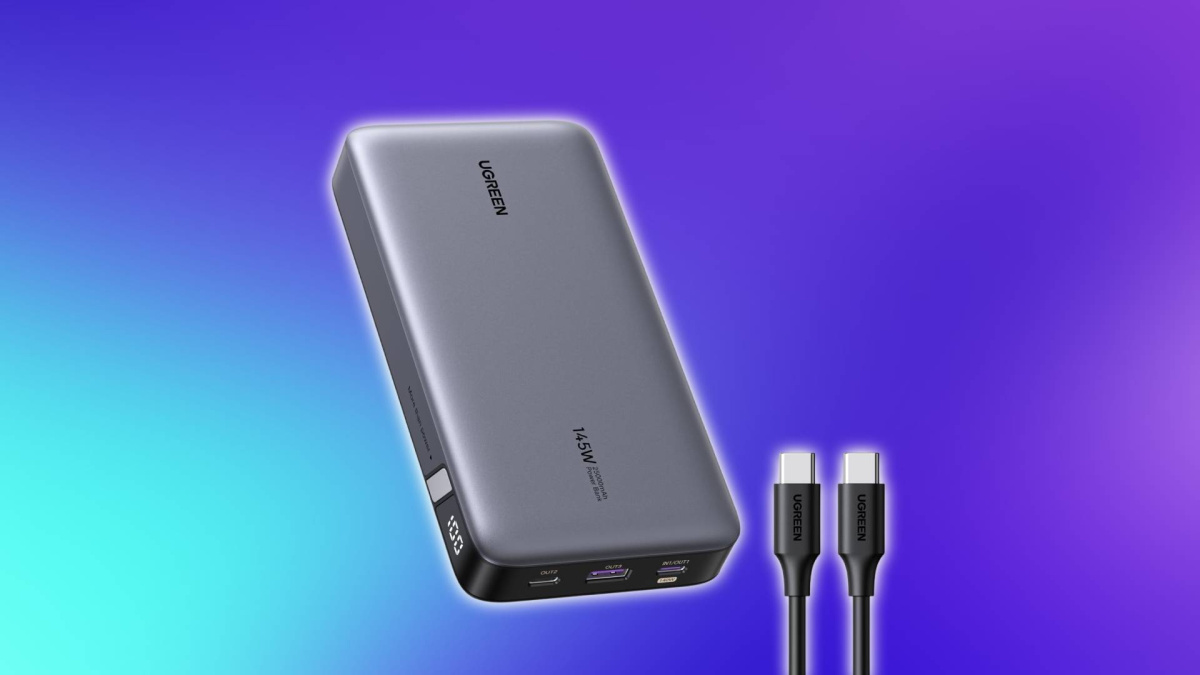
Ugreen's 145W Power Bank: The Deal's Promise
The Ugreen Nexode Power Bank is presented as a robust solution for mobile power needs, capable of charging up to three devices simultaneously. It features a 145W peak output from one of its two USB-C ports, complemented by a 65W second USB-C port and a 22.5W USB-A port. This, combined with a substantial 25,000 mAh lithium-ion battery, positions it as a powerhouse designed to keep laptops, smartphones, and handheld consoles running far from a wall socket. The article highlights its compact size (16 x 8.1 x 2.7 cm) and weight (505g), along with a digital LED display showing the battery percentage, and compatibility with various fast-charging protocols including Power Delivery, Quick Charge, and Samsung PPS. Notably, Ugreen claims the power bank can charge a 2022 MacBook Pro 14-inch from 0 to 50 percent in just 30 minutes, and fully recharge an iPhone 15 up to 5.5 times.
What the Price Drop Actually Means
The claim of 'lowest price in months' is a carefully chosen metric that, while technically accurate, can often mask the true historical context of a product's pricing. In my 12 years of observing hardware logistics and consumer electronics markets across Europe, I've learned that prices rarely move in a linear fashion. What constitutes a 'lowest price in months' can often be a return to a regular, cyclical sale price after a brief period of inflated pricing, rather than a genuine, unprecedented bargain.
Consider the concurrent Anzeige for the Tapo L530E smart light bulb, also published by Golem.de. While it touts a 'Jahrestiefstpreis' (year-low price) of 6,79 Euro, it explicitly adds a crucial detail: 'Der bisherige Bestpreis aus dem August 2025 lag nur 50 Cent darunter.' This honest disclosure offers a refreshing contrast. It reveals that a 'year-low' isn't necessarily an 'all-time low,' and that the difference can be marginal. For the Ugreen power bank, the claim of 'nicht günstiger, auch nicht am Prime Day' certainly sounds impressive, but without the full historical price graph, it's difficult to ascertain if this is truly an outlier price or simply a predictable dip in a well-established pricing pattern.
Is 145W Still a Differentiator?
The Ugreen Nexode's headline feature is its 145W peak output. For many users, particularly those with high-performance laptops like recent MacBook Pro models or gaming notebooks, this level of power delivery can indeed be a significant advantage, ensuring faster charging times than more common 65W or 100W power banks. However, we must ask: for whom is 145W truly necessary? A large segment of the market, including many ultrabooks and even some mid-range gaming laptops, operate perfectly well with 65W or 100W USB-C Power Delivery.
The emphasis on 145W might be more about marketing differentiation than about genuine, widespread user need. What's still unclear is the sustained output at 145W, or how thermal management impacts performance during prolonged high-power delivery. Without independent benchmarks, these figures remain speculative.
The Real Cost of 'Lowest Price in Months'
The perceived value of a deal isn't solely about the initial purchase price; it's also about long-term reliability and performance. The Golem.de article acknowledges feedback from Amazon customers, noting that over 7,000 reviewers give the Ugreen Nexode an average of 4.4 out of 5 stars, praising 'Verarbeitung, Ladegeschwindigkeit und Kapazität.' However, it also mentions a crucial point of criticism: 'Kritik gibt es lediglich für die Zuverlässigkeit, da manche Nutzer Montagsmodelle erwischt haben.' This downplaying of reliability concerns is problematic.
A 'Monday model' is not a trivial issue; it represents a quality control failure that can lead to frustration, data loss, or even safety hazards for the user. A 'lowest price in months' becomes far less attractive if the device fails prematurely, leading to the hidden costs of replacement, shipping, and downtime. This highlights a broader trend in the accessory market: a race to the bottom on price often comes at the expense of consistent quality.
Navigating Deal Journalism
The existence of these Anzeige articles on a respected tech publication like Golem.de reflects the evolving economics of online journalism. Affiliate marketing has become a significant revenue stream. There's nothing inherently wrong with this model, but it places a higher burden on the reader — and on us as editors — to critically evaluate the content.
What's still unclear from these pieces is a genuine, unbiased comparison of the Ugreen Nexode against its direct competitors at this price point. Is it truly the best value 145W power bank, or simply a 145W power bank currently at a promotional price? We don't see analysis of its long-term battery degradation, the efficiency of its power conversion, or its environmental footprint compared to alternatives.
Ultimately, articles like the one on the Ugreen Nexode Power Bank serve as a reminder that a 'deal' is only as good as the value it truly offers. For our readers, the takeaway should be this: always look beyond the headline price. Consider the product's long-term reliability, compare its features against your actual needs, and always be wary of claims that lack independent verification. A true bargain isn't just about the lowest number on the price tag; it's about robust performance, enduring quality, and a genuine fit for your operational requirements, especially here in Europe where we value longevity and sensible engineering over ephemeral hype.
Sources cross-referenced
This story was synthesised from reporting by 4 outlets:
Discuss this story
Got a take, a correction, or a follow-up tip? Reply where you read — we read everything.
Found an error? File a correction at /corrections. Substantive corrections are logged publicly.
One short email. The most important Hardware news, fact-checked, no fluff. Free, unsubscribe anytime.
More from Hardware

Apple's AI Pivot: Vision Pro Content Cut, Siri Rebuilt Amid Layoffs
Apple's latest layoffs signal a strategic pivot, dialing back high-cost Vision Pro content while re-tooling Siri for the AI era. What's next for Apple?

Povasee A30 Jump Starter: A 50-Euro Deal With 5,000A Claims Under Scrutiny
The Povasee A30 jump-start power bank, on offer at Amazon for under 50 Euros, claims 5,000A peak current. We scrutinize this deal against real-world expectations.

Ugreen's 200W Charger: Powerhouse or Marketing Hype?
We analyze the Ugreen 200W charger's technical prowess, real-world utility, and the Amazon deal, highlighting its strengths and limitations

Victorinox Amazon Deals: Tactics or True Value?
Byte-Pulse examines Amazon's Victorinox deals, dissecting the true value of the Swiss Card Lite and Synergy X Alox against market trends.
The Byte-Pulse Newsroom is the editorial system that produces Byte-Pulse's daily tech news coverage. Each story is cross-referenced across 3+ independent outlets, drafted with AI assistance by the newsroom system (Drafter → Editor → Fact-Checker → Polisher), and reviewed by Serhat Er, Editor-in-Chief, before publication. We disclose AI augmentation openly. Editorial accountability stays with the named editor on every article. Tips: editorial@byte-pulse.net.
Don’t miss these
Honor Magic 8 Pro vs Samsung Galaxy S26 Ultra: Which Future Flagship Fits Your Wallet and Workflow?
Deciding between the anticipated Honor Magic 8 Pro and Samsung Galaxy S26 Ultra? Our deep dive into expected specs and features provides the fair comparison you need.
Proton VPN vs NordVPN: Which One Earns Your Subscription?
A deep dive into Proton VPN and NordVPN, comparing their privacy, performance, features, and value, helping you make an informed decision.
Perplexity Pro vs ChatGPT Plus: Which AI Assistant Fits Your Workflow?
This guide lays out the strengths and approaches of Perplexity Pro and ChatGPT Plus, helping you identify which AI assistant aligns with your specific needs.

Pokémon TCG Movie Signals Strategic Media Pivot for The Pokémon Company
A new Pokémon movie focused on the TCG is coming in 2027, marking a strategic pivot for the franchise as it navigates massive global fan engagement and logistical challenges.
Xiaomi 16 Pro vs iPhone 18 Pro: Which Flagship Fits Your World?
Deciding between the Xiaomi 16 Pro and iPhone 18 Pro? We break down every spec and trade-off, so you can make the choice that's right for you.
Notion vs Obsidian: Which Knowledge Hub Fits Your Workflow?
Deciding between Notion and Obsidian? We break down the core differences in philosophy, data ownership, collaboration, and extensibility to help you choose.