Anker Balkonkraftwerk Deal: Beyond the €977 Price Tag
Golem highlights a sub-1000 Euro 'Balkonkraftwerk' bundle from Kleines Kraftwerk, but real-world value hinges on regulatory clarity and installation realities.

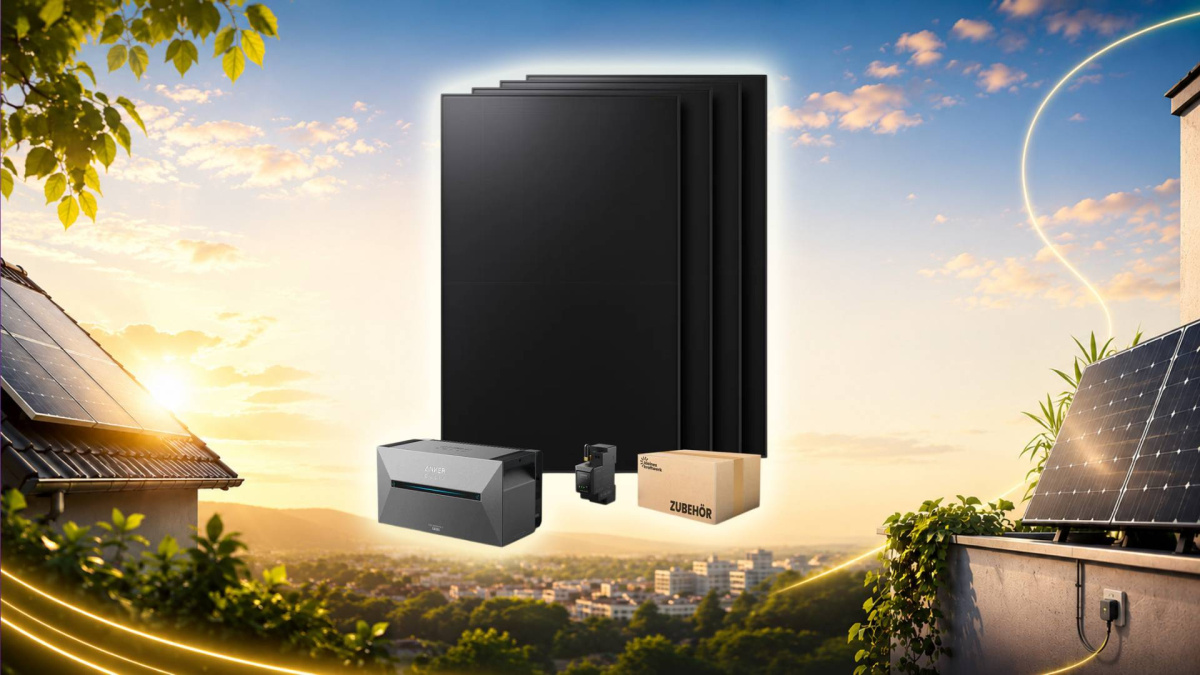
When Golem recently highlighted an exclusive deal for a Balkonkraftwerk — a plug-in solar system for homes — it caught our attention, not least because it bundles a substantial 1.92 kWp of solar capacity with an Anker SOLIX battery storage solution for a price point just under 1,000 Euro. This kind of aggressive pricing for distributed energy generation is a trend we've been tracking across Europe, particularly as energy prices remain volatile. While other Anzeige articles from Golem this week, covering unrelated Mini-PCs and USB chargers, didn't pertain to this story, this specific offer demands a closer look, especially through the pragmatic lens of actual deployment and long-term value.
What is a Balkonkraftwerk and why should you care?
A Balkonkraftwerk — literally a "balcony power plant" — is a small, plug-in photovoltaic system designed for residential use, typically installed on balconies, terraces, or even small garden plots. Unlike large rooftop installations, these micro-PV systems are characterized by their simplicity and relatively low entry barrier. They usually consist of one to four solar panels, a micro-inverter that converts the panels' DC electricity into grid-compatible AC, and a simple plug (often a Schuko plug in Germany) that connects directly into a household electrical socket. The primary goal is Eigenverbrauch (self-consumption), reducing the amount of electricity drawn from the public grid and, consequently, lowering electricity bills.
From an operator's perspective, the rise of Balkonkraftwerke represents a fascinating decentralization of energy infrastructure. For decades, electricity generation was a massive, centralized undertaking. Now, with increasingly efficient and affordable solar technology, individual households can contribute, even if only on a small scale. This shift isn't just about saving money; it's about resilience and a degree of energy independence, which is becoming increasingly attractive in the face of geopolitical uncertainties impacting gas and electricity markets across the EU. The German government, for instance, has recently eased regulations, raising the permitted inverter output for plug-in systems from 600 Watts to 800 Watts, further boosting their appeal.
The Quattro (BC) system: Panels, Storage, and Smart Meter explained
The Golem-featured deal, offered by Kleines Kraftwerk, centers around their "Balkonkraftwerk Quattro (BC)" system. At its core are four Sunpro-BC-Glas-Glas-modules, each rated at 480 Wp, culminating in a substantial total nominal power of 1,920 Wp. The "BC" in the module name refers to Back-Contact cells, which typically offer higher efficiency by moving the electrical contacts to the rear of the cell, maximizing the front surface for light absorption. Furthermore, these are bifazial modules, meaning they can capture sunlight from both the front and the back side, potentially yielding more energy from reflected light, a detail Golem notes can lead to "Mehrertrag" (additional yield) "unter optimalen Bedingungen." Anyone who's worked with real-world solar deployments knows optimal conditions are often elusive, so while bifaciality is a technical advantage, quantifying its real-world benefit for a balcony setup requires site-specific analysis.
Crucially, the bundle includes the Anker SOLIX Solarbank 2 Pro. This unit serves as the battery storage, boasting a 1.6 kWh capacity. What makes this particularly relevant is the integrated inverter, simplifying the setup by combining two critical components into one IP65-rated, weather-resistant enclosure. The Solarbank 2 Pro is designed for flexibility, allowing expansion up to a substantial 15.1 kWh by adding up to five BP2700 auxiliary batteries, each priced at 699 Euro. This modularity is a smart move, allowing users to scale their storage as their needs or budget evolve. A kostenloses Smart Meter (free Smart Meter) is also part of the package, enabling real-time consumption monitoring via the Anker app, which is essential for maximizing Eigenverbrauchsquote (self-consumption rate).
How the Anker SOLIX Solarbank 2 Pro stores your surplus energy
The core utility of the Anker SOLIX Solarbank 2 Pro lies in its ability to store surplus solar energy generated during peak sunshine hours for use later, typically in the evening when household consumption often rises but solar production has ceased. Without storage, any excess electricity generated beyond immediate household demand is fed back into the grid, often for a minimal or non-existent feed-in tariff for Balkonkraftwerke. By storing this energy, you effectively shift your consumption profile, significantly increasing your Eigenverbrauchsquote and reducing reliance on grid electricity when prices are often higher.
Honestly, this is where the true value of such a system resides for most European households. The initial investment in a Balkonkraftwerk pays off much faster when you can use nearly all the electricity you generate. The Golem article also highlights a practical emergency feature: an external 1,000-Watt output socket on the Solarbank 2 Pro, allowing critical devices like refrigerators or mobile phones to be powered during Blackout-like situations. While this offers a degree of peace of mind, it's important to remember that this isn't a whole-home backup solution, but rather a robust power bank for essential loads.
The Golem exclusive deal: Price, availability, and potential savings
The Kleines Kraftwerk deal, as reported by Golem, offers this comprehensive Balkonkraftwerk Quattro (BC) bundle for an exclusive price of 977 Euro for Golem readers, claiming to be über 630 Euro unter der angegebenen UVP (over 630 Euro below the stated RRP). This is a compelling price point, especially considering the inclusion of four bifacial panels and the expandable Anker SOLIX storage unit. For comparison, entry-level 600-Watt Balkonkraftwerke without storage often start at around 400-600 Euro, so adding a 1.6 kWh battery for under 1,000 Euro represents strong value.
The deal includes kostenloser Versand innerhalb Deutschlands per Spedition (free shipping within Germany via freight forwarder), which is a non-trivial saving given the size and weight of solar panels and batteries. Optional statisch geprüfte Halterungen "Made in Germany" (structurally tested mounts "Made in Germany") are available for an additional 178 Euro, a sensible investment for safety and longevity. Kleines Kraftwerk projects 4.838 Euro in savings over ten years and an Amortisationszeit (amortization period) of just 2,3 Jahren for a medium-sized household (3,000 kWh/year) with low daytime and high evening consumption. While these figures are attractive, I'm inherently skeptical of such generalized `Modellrechnungen` (model calculations) without detailed, independently verifiable parameters. Actual savings are highly dependent on individual consumption patterns, local electricity prices, sun hours at the specific location, and the precise Eigenverbrauchsquote achieved.
Beyond the deal: Expanding your system and future-proofing
The modularity of the Anker SOLIX Solarbank 2 Pro, with its ability to add up to five BP2700 batteries for a total of 15.1 kWh, is a significant future-proofing aspect. As energy demands grow or as households invest in electric vehicles or heat pumps, scalable storage becomes increasingly important. However, it's essential to consider the regulatory landscape. While the German Meldepflicht (registration requirement) for Balkonkraftwerke is relatively straightforward (Bundesnetzagentur and local grid operator), scaling up beyond certain thresholds might involve more complex procedures or even require professional electrical installation, which adds to the overall cost and complexity.
What's still unclear from the Golem article, and indeed from many such deal-focused announcements, are several critical details for a hardware operator:
- Inverter Output Limit: The system features 1,920 Wp of panel power. However, standard
Balkonkraftwerkein Germany are typically capped at 600W or 800W inverter output. While the Anker Solarbank 2 Pro has an integrated inverter, its specific maximum AC output is not stated. If it's limited to 800W, a significant portion of the panel's potential output would be clipped, especially on sunny days. This is a crucial technical specification that directly impacts real-world yield. - Long-Term Battery Performance: While a 10-year warranty and 15-year expected lifespan for the Solarbank 2 Pro are good, real-world degradation of LFP batteries (which Anker typically uses, though not specified here) over such a long period, especially under varying charge/discharge cycles and temperature extremes, needs to be factored into long-term savings projections.
- Installation Effort & Hidden Costs: Beyond the optional mounts, what about the actual physical installation, cabling, and necessary electrical checks? For a 1.92 kWp system with battery storage, even if plug-and-play, proper installation can be more involved than for a single-panel setup.
- EU-Wide Applicability: The deal is
innerhalb Deutschlands. How do similar systems fare under the diverse regulatory frameworks and subsidy schemes across other EU member states? The administrative hurdles and technical requirements vary wildly from, say, France to Poland, impacting broader market relevance.
This Balkonkraftwerk deal from Kleines Kraftwerk is undeniably attractive on paper, especially with the included Anker SOLIX storage, which is a sensible addition for maximizing Eigenverbrauch. However, as with any hardware investment that promises long-term savings, the devil is in the details of deployment, regulatory compliance, and realistic performance expectations. For you, the Byte-Pulse reader, understanding these nuances — beyond the headline price — is what truly empowers an informed decision in the evolving landscape of decentralized energy.
Sources cross-referenced
This story was synthesised from reporting by 3 outlets:
Discuss this story
Got a take, a correction, or a follow-up tip? Reply where you read — we read everything.
Found an error? File a correction at /corrections. Substantive corrections are logged publicly.
One short email. The most important Hardware news, fact-checked, no fluff. Free, unsubscribe anytime.
More from Hardware
Razer Blade 16 (2026) vs ASUS ROG Zephyrus G16 (2026): Which Next-Gen Powerhouse Fits Your Workflow?
Deciding between Razer's premium Blade 16 2026 and ASUS's versatile ROG Zephyrus G16? We cut through the hype to lay out the real trade-offs.
HP Spectre x360 2026 vs MacBook Air M5: Which Flagship Laptop Fits Your Future?
Deciding between the versatile HP Spectre x360 2026 and the efficient MacBook Air M5 means weighing form factor, operating system, and core priorities.
Framework Laptop 16 vs Lenovo ThinkPad X1 Carbon Gen 13: The Future-Proofed Powerhouse vs. The Enduring Executive
This guide cuts through the marketing to compare the modular Framework 16 and the svelte ThinkPad X1 Carbon Gen 13, helping you choose without bias.
MacBook Air M5 vs. Surface Laptop 7: The ARM-Powered Laptop Showdown
Deciding between the next MacBook Air and Surface Laptop means weighing operating systems, ecosystems, and subtle design choices. Find your fit.
The Byte-Pulse Newsroom is the editorial system that produces Byte-Pulse's daily tech news coverage. Each story is cross-referenced across 3+ independent outlets, drafted with AI assistance by the newsroom system (Drafter → Editor → Fact-Checker → Polisher), and reviewed by Serhat Er, Editor-in-Chief, before publication. We disclose AI augmentation openly. Editorial accountability stays with the named editor on every article. Tips: editorial@byte-pulse.net.
Don’t miss these
Asus ROG Phone 9 vs Sony Xperia 1 VII: Which Niche Flagship Earns Your Money?
Deciding between the gaming-focused ROG Phone 9 and the creator-centric Xperia 1 VII? This guide breaks down every spec to help you choose.
Proton VPN vs NordVPN: Which One Earns Your Subscription?
A deep dive into Proton VPN and NordVPN, comparing their privacy, performance, features, and value, helping you make an informed decision.
Perplexity Pro vs ChatGPT Plus: Which AI Assistant Fits Your Workflow?
This guide lays out the strengths and approaches of Perplexity Pro and ChatGPT Plus, helping you identify which AI assistant aligns with your specific needs.

Pokémon TCG Movie Signals Strategic Media Pivot for The Pokémon Company
A new Pokémon movie focused on the TCG is coming in 2027, marking a strategic pivot for the franchise as it navigates massive global fan engagement and logistical challenges.
Honor Magic 8 Pro vs Samsung Galaxy S26 Ultra: Which Future Flagship Fits Your Wallet and Workflow?
Deciding between the anticipated Honor Magic 8 Pro and Samsung Galaxy S26 Ultra? Our deep dive into expected specs and features provides the fair comparison you need.
Notion vs Obsidian: Which Knowledge Hub Fits Your Workflow?
Deciding between Notion and Obsidian? We break down the core differences in philosophy, data ownership, collaboration, and extensibility to help you choose.