NASA's Psyche Snaps Stunning Mars Photos During Flyby
Psyche captures Mars' surface ahead of its journey to the metallic asteroid 16 Psyche.

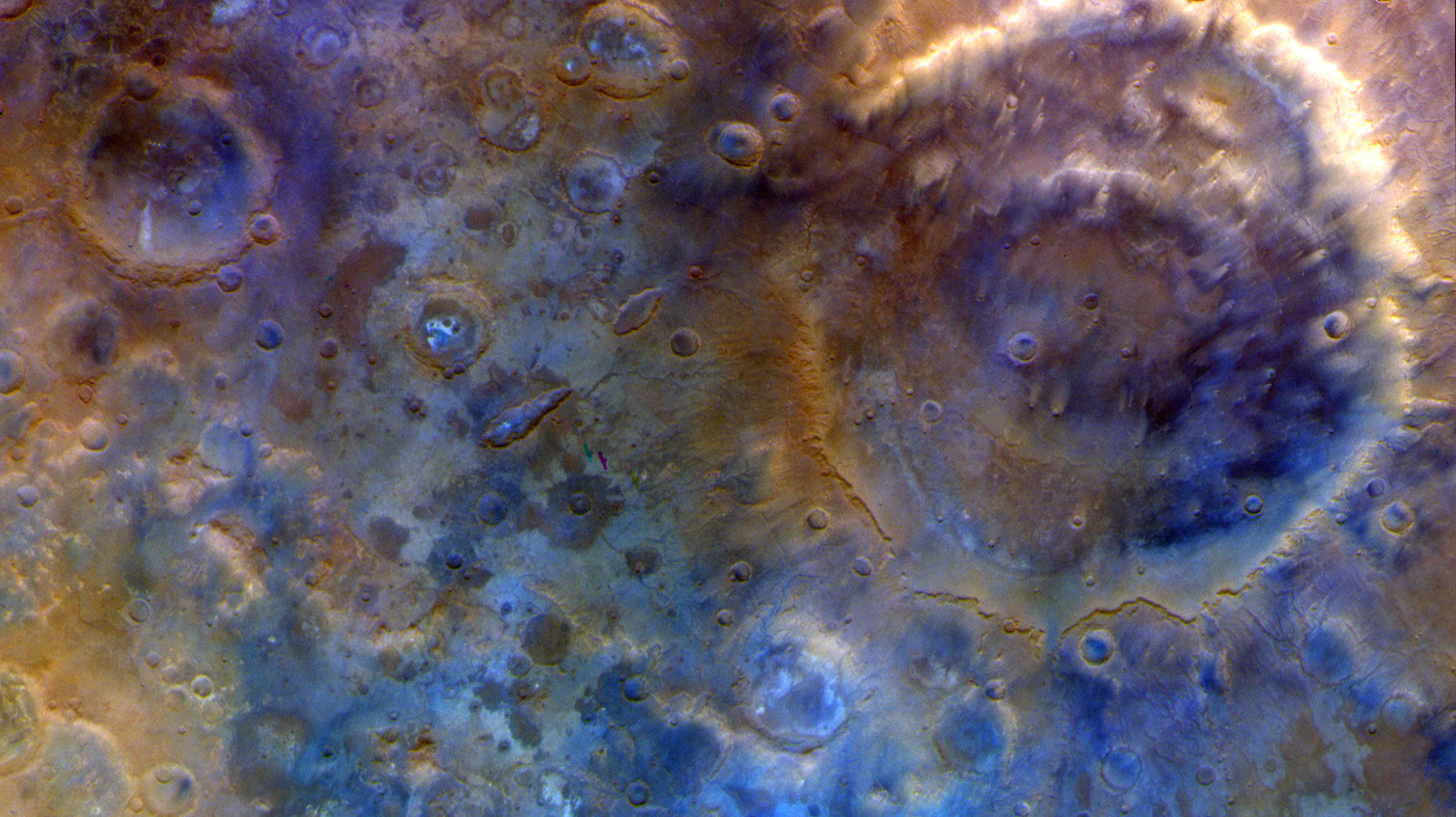
NASA has unveiled a series of captivating images taken by the Psyche spacecraft during its recent flyby of Mars. This maneuver was a strategic move to gain a gravity assist from the red planet, propelling Psyche further on its six-year mission to the metallic asteroid 16 Psyche.
Close Encounter with Mars
The flyby of Mars by NASA's Psyche spacecraft was not just a routine maneuver; it was an opportunity to gather unprecedented data and images of the planet. As Psyche approached Mars, it captured a breathtaking view of the planet's crescent shape. This stunning image was a result of sunlight reflecting off both the Martian surface and its dusty atmosphere, creating a luminous crescent that extended beyond the usual visibility of the planet's surface. This crescent view is similar to how we see a crescent moon from Earth, offering a fresh perspective on Mars.
One of the highlights from the flyby is an enhanced image of the Huygens double-ring crater. This 290-mile-diameter crater, with its vivid colors, illustrates the diverse composition of Martian dust, sand, and bedrock. NASA enhanced these colors to highlight the differences more clearly, providing valuable data for scientists. The crater's intricate patterns and hues tell a story of Mars' geological history, including the impact events and the subsequent erosion processes.
Southern Pole in Focus
Following its closest approach, Psyche turned its attention to Mars' southern pole, capturing a high-resolution image of this less frequently observed region. The southern pole of Mars is a captivating area for scientists due to its vast ice fields, which appear as bright spots in the photograph taken by Psyche. These ice fields are composed primarily of water and carbon dioxide ice, which remain solid year-round, offering a glimpse into the planet’s climatic conditions. Understanding the distribution and composition of these ice fields is crucial for insights into Mars' current and past climate.
The Journey Continues
After successfully leveraging Mars' gravity, Psyche will continue its journey using its solar-electric propulsion system, a technology that allows for efficient long-duration space travel. The spacecraft, which started its odyssey in October 2023, is slated to reach the asteroid 16 Psyche by 2029. Upon arrival, Psyche will spend two years orbiting and examining the asteroid, which is the largest known metallic body in our solar system. This mission will provide an unprecedented opportunity to study an object that is thought to be the exposed core of a protoplanet, offering a window into the building blocks of planet formation.
Context
This mission is crucial for understanding the early stages of planetary formation. By studying 16 Psyche, scientists hope to gain insights into the formation of Earth's core, as the asteroid is believed to share similarities with the building blocks of terrestrial planets. The European Space Agency (ESA) has similar missions planned, reflecting a robust interest in planetary science across the continent. The collaboration and shared scientific goals underscore the global interest in unlocking the secrets of our solar system's formation.
What this means for you
For space enthusiasts and scientists alike, these images not only provide a stunning view of Mars but also highlight the technological advancements in space exploration. The data from Psyche could lead to groundbreaking discoveries about planetary cores, potentially impacting our understanding of Earth's history and formation. Whether you're an aspiring scientist or simply a fan of space exploration, the images and data from Psyche offer a tangible connection to the frontier of human discovery.
Consider a real-world application: the technology and insights gained from missions like Psyche could inform future endeavors, such as asteroid mining or even manned missions beyond Mars. The knowledge we acquire about metallic asteroids might one day help humanity harness resources from space, reducing the environmental impact of mining on Earth.
What's still unclear
While the mission is on track, questions remain about the specific scientific findings Psyche will uncover once it reaches the asteroid. Will the data confirm current theories about the planet's core formation, or will it challenge existing paradigms? The metallic composition of 16 Psyche might reveal new facets of planetary differentiation—the process by which a planet forms layers, such as a core, mantle, and crust. However, until Psyche reaches its destination and begins its detailed observations, many of these questions will remain unanswered.
Why this matters
NASA's Psyche mission offers a unique glimpse into the mysteries of our solar system. By studying a metallic asteroid up close, we can potentially unlock secrets about the Earth's formation and the broader universe. This mission not only advances our scientific knowledge but also reinforces international collaboration in space exploration, a venture where Europe plays a significant role. The data gathered could have far-reaching implications, influencing everything from our understanding of geology to the future of space resource utilization.
The mission's success could pave the way for future missions that further explore our solar system's hidden corners, continuing humanity's journey of exploration and discovery. Each new piece of data collected helps piece together the complex puzzle of our universe, bringing us closer to answering some of the most profound questions about our origins and our place in the cosmos.
Discuss this story
Got a take, a correction, or a follow-up tip? Reply where you read — we read everything.
Found an error? File a correction at /corrections. Substantive corrections are logged publicly.
One short email. The most important Science news, fact-checked, no fluff. Free, unsubscribe anytime.
More from Science
Quantum Computing Explained for Developers: A 2026 Update
Explore quantum computing fundamentals, hardware, and how it impacts software development in this comprehensive guide for developers.
Quantum Computing Advances: Key Updates from Microsoft, Atom, and EeroQ
Microsoft, Atom Computing, and EeroQ share key updates in their quantum computing efforts, marking steady progress toward practical applications.

Star City Explores the Human Cost Behind the Soviet Space Program
Forget Mars colonies. Star City, the new spin-off from For All Mankind, dives deep into the gritty, dangerous, and often ethically complex world of the Soviet space program in the late 1960s.
A Gritty, High-Stakes Drama: Exploring the Soviet Space Program in Star City
Explore the untold story of the Soviet space program in Star City, a new Apple TV+ series that swaps the familiar American perspective for a gritty, high-stakes drama centered on its visionary, yet constrained, leadership.
The Byte-Pulse Newsroom is the editorial system that produces Byte-Pulse's daily tech news coverage. Each story is cross-referenced across 3+ independent outlets, drafted with AI assistance by the newsroom system (Drafter → Editor → Fact-Checker → Polisher), and reviewed by Serhat Er, Editor-in-Chief, before publication. We disclose AI augmentation openly. Editorial accountability stays with the named editor on every article. Tips: editorial@byte-pulse.net.
Don’t miss these
Asus ROG Phone 9 vs Sony Xperia 1 VII: Which Niche Flagship Earns Your Money?
Deciding between the gaming-focused ROG Phone 9 and the creator-centric Xperia 1 VII? This guide breaks down every spec to help you choose.
Proton VPN vs NordVPN: Which One Earns Your Subscription?
A deep dive into Proton VPN and NordVPN, comparing their privacy, performance, features, and value, helping you make an informed decision.
Perplexity Pro vs ChatGPT Plus: Which AI Assistant Fits Your Workflow?
This guide lays out the strengths and approaches of Perplexity Pro and ChatGPT Plus, helping you identify which AI assistant aligns with your specific needs.

Pokémon TCG Movie Signals Strategic Media Pivot for The Pokémon Company
A new Pokémon movie focused on the TCG is coming in 2027, marking a strategic pivot for the franchise as it navigates massive global fan engagement and logistical challenges.

Apple's AI Pivot: Vision Pro Content Cut, Siri Rebuilt Amid Layoffs
Apple's latest layoffs signal a strategic pivot, dialing back high-cost Vision Pro content while re-tooling Siri for the AI era. What's next for Apple?
Honor Magic 8 Pro vs Samsung Galaxy S26 Ultra: Which Future Flagship Fits Your Wallet and Workflow?
Deciding between the anticipated Honor Magic 8 Pro and Samsung Galaxy S26 Ultra? Our deep dive into expected specs and features provides the fair comparison you need.