Airbus A350-1000ULR Jet Completes First Ultra-Long-Haul Flight
The new variant, designed for non-stop Australia-to-Europe routes, took to the skies for its maiden test flight.

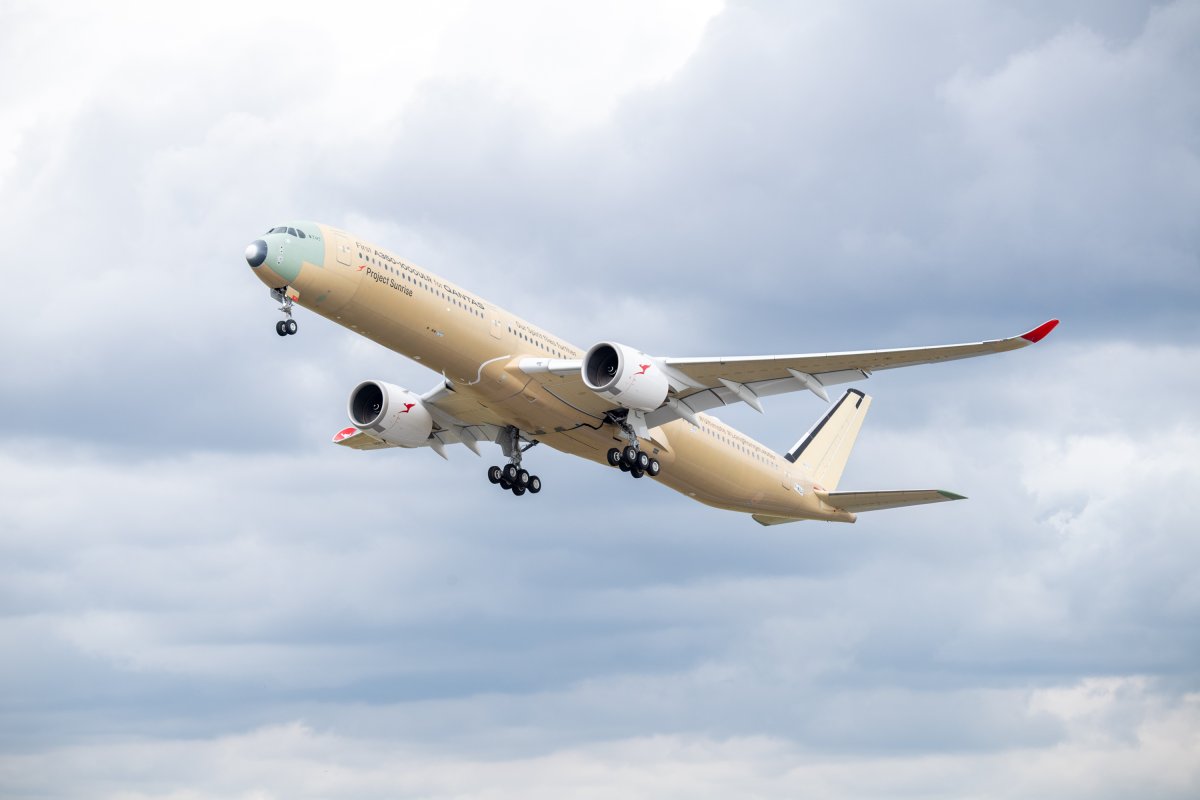
Airbus A350-1000ULR Jet Completes First Ultra-Long-Haul Flight
Airbus has just successfully completed the maiden flight of its brand-new A350-1000ULR ultra-long-range passenger jet. This specialized variant, meticulously configured for Qantas Airways, took to the skies from Airbus’s manufacturing hub in Toulouse, France. The initial test flight, a crucial milestone, lasted a significant three hours and 43 minutes. This particular aircraft, bearing the serial number 707, is engineered to achieve an operational range of approximately 10,000 nautical miles, which translates to an impressive 18,520 kilometers. Imagine the possibility of non-stop journeys from Sydney, Australia, all the way to London, England – a route that has long been a dream for many travelers. This development finally brings that vision closer to reality.
A New Fuel System for Extreme Range
The A350-1000ULR is not merely an incremental upgrade to the existing A350 family; it represents a substantial leap forward in long-distance aviation capabilities. The key innovation enabling this extended range is a sophisticated new fuel system. Central to this is an added central fuel tank and an integrated fuel management system. This new configuration, a core component of what Airbus and Qantas have dubbed "Project Sunrise," incorporates an additional Rear Center Tank (RCT) seamlessly integrated into the aircraft’s fuselage. Airbus estimates that this dedicated RCT alone contributes an additional 1,852 kilometers (approximately 1,000 nautical miles) to the aircraft's maximum range, a remarkable enhancement over the standard A350-1000 model.
During this pivotal test flight, a highly experienced crew comprising test pilots and engineers, including key personnel like Thomas Wilhelm and Anthony Flynn, meticulously put the aircraft through its paces. They pushed the A350-1000ULR to operational altitudes, reaching up to 41,000 feet, which is roughly equivalent to 12,500 meters. While Airbus has remained tight-lipped about the specific speeds or the precise distance covered during this initial test hop, the aircraft is fundamentally designed for endurance, capable of remaining airborne for up to 22 hours continuously. This level of sustained flight time is truly extraordinary in the realm of commercial aviation.
To put this into perspective, a 22-hour flight means that from the moment the wheels leave the runway until they touch down again, a significant portion of a day is spent in the air. For passengers, this translates to experiencing multiple sunsets and sunrises from 40,000 feet. This capability opens up a new paradigm for travel, making direct routes between continents that were previously impractical or impossible a tangible reality. The sheer engineering feat required to achieve this endurance, while maintaining safety and efficiency, is a testament to the advancements in aerospace technology.
Beyond Fuel: Cabin Innovations for Marathon Flights
While the extended range is undoubtedly the headline feature, Airbus has not overlooked the critical aspect of passenger comfort on these marathon journeys. Recognizing that spending upwards of 18 to 22 hours in a pressurized cabin presents unique challenges, significant attention has been paid to onboard amenities. A notable innovation is a lighter, more energy-efficient air cooling system specifically designed for the aircraft's galleys. This system is crucial for maintaining optimal conditions in areas where food and beverages are prepared, ensuring freshness and operational efficiency even during the longest flights. Furthermore, the cabin's overall ventilation and temperature control systems have undergone refinements. These adjustments aim to create a more stable and comfortable environment for passengers, mitigating the potential discomfort associated with prolonged exposure to recycled air and varying cabin pressures. The goal is to ensure that passengers arrive at their destination feeling as refreshed as possible, rather than feeling fatigued and drained from the extended travel time.
Consider a typical day: you might wake up, have breakfast, commute to work, have lunch, work through the afternoon, commute home, have dinner, and then go to bed. A 22-hour flight encompasses roughly three times that duration spent in the air. The design considerations for the cabin, from air quality to temperature regulation, are therefore paramount in making such an experience not just survivable, but genuinely comfortable. The focus on these 'softer' aspects of the flight experience underscores a holistic approach to ultra-long-haul travel, acknowledging that the journey itself is as important as the destination.
What's Next for the A350-1000ULR?
This successful first flight marks only the beginning of the A350-1000ULR’s journey towards commercial service. A comprehensive flight testing campaign, scheduled to span two months, is now underway. Following the completion of these rigorous tests, the newly implemented systems will undergo a thorough certification process by aviation authorities. Only after receiving the necessary approvals will the aircraft proceed to its final configuration, tailored to Qantas's specific operational and aesthetic requirements. Airbus is currently targeting April 2027 for the delivery of the very first A350-1000ULR to Qantas. Significantly, a second aircraft is already in advanced stages of production. This second jet is expected to emerge from the paint shop shortly, after which it will receive its sophisticated four-class cabin interior and have its powerful engines fitted.
Qantas has placed a substantial order for twelve of these A350-1000ULRs, all intended for its ambitious "Project Sunrise" initiative. The overarching objective of Project Sunrise is to fundamentally transform air travel between Australia and Europe, eliminating the need for lengthy and often inconvenient stopovers. To complement this, Qantas has also ordered twelve standard A350-1000 aircraft, indicating a strong commitment to the A350 family. The entire A350 family, which includes the -900, the -900ULR, the -1000, and now the -1000ULR, is renowned for its fuel-efficient engines. These advanced powerplants are not only designed to significantly reduce carbon dioxide emissions compared to older generation aircraft but also offer a high passenger capacity, with the A350-1000 variant capable of accommodating up to 480 passengers in a typical configuration.
Context: These ultra-long-haul flights, collectively referred to as "Project Sunrise" by airlines, represent a significant undertaking in the aviation industry. Qantas, in particular, has a storied history of pioneering long-distance routes, having previously operated its iconic Boeing 747-400 aircraft on some of the world's longest flights. If the A350-1000ULR performs as anticipated, it will unlock the potential for direct, non-stop flights from Australia to major European hubs like London and Paris. This would dramatically reduce travel times, offering a revolutionary new option for premium travelers and potentially reshaping the landscape of long-haul air travel.
What this means for you: For passengers dreaming of traversing the globe from Sydney to London without a single layover, this aircraft is the key. Its successful test flight has moved this possibility from the realm of aspiration to tangible reality. Travelers can anticipate a significant reduction in overall journey times, potentially saving many hours compared to current flight options. Moreover, the advancements in cabin design suggest that these ultra-long flights might offer a more comfortable and less taxing experience than previously imagined. As Qantas finalizes its cabin configurations and operational plans, more details regarding booking and specific flight schedules are expected to emerge closer to the 2027 delivery date.
What's still unclear: While the arrival timeline and the general purpose of the A350-1000ULR are well-defined, several key details remain subjects of speculation. Beyond the widely discussed Sydney-London route, the exact network of ultra-long-haul destinations that Qantas plans to serve with these aircraft has not yet been fully disclosed. Furthermore, the precise seating configurations for each of the twelve Qantas aircraft, which will likely vary across different cabin classes to optimize passenger comfort and revenue, are still unknown. Consequently, the ticket prices for these unprecedented super-long flights remain a significant question mark. On the technical front, while the new cooling system is a promising innovation, its real-world performance under the extreme conditions of a 22-hour flight, and its subsequent impact on airline operating costs, are yet to be determined.
Why this matters: The successful test flight of Airbus’s A350-1000ULR is more than just a technical achievement; it represents a significant stride in pushing the boundaries of aviation technology. It is transforming the concept of ultra-long-haul passenger flights from a niche possibility into a viable commercial reality. This development has the potential to fundamentally reshape global connectivity, making distant corners of the world more accessible and altering the way we perceive and experience international travel. It signals a new era where the tyranny of distance in air travel is significantly diminished.
Discuss this story
Got a take, a correction, or a follow-up tip? Reply where you read — we read everything.
Found an error? File a correction at /corrections. Substantive corrections are logged publicly.
One short email. The most important Hardware news, fact-checked, no fluff. Free, unsubscribe anytime.
More from Hardware
NVIDIA RTX 4070 Ti Super vs. RTX 5070 (Rumored): The 'Buy Now or Wait' Dilemma
Deciding between a powerful current-gen GPU and the promise of next-gen performance requires a clear-eyed look at immediate needs versus future potential. This guide lays out the trade-offs.
RTX 5060 Ti vs RX 9060 XT: Which Mid-Range Powerhouse Fits Your Rig?
Deciding between the rumored RTX 5060 Ti and RX 9060 XT? This guide cuts through the noise to highlight the real-world trade-offs for gamers and creators.
Lenovo Legion Pro 7i 2026 vs Razer Blade 16 2026: Which Flagship Gaming Laptop Fits Your Future?
Deciding between the next-gen Lenovo Legion Pro 7i and Razer Blade 16 means weighing peak performance against premium design and a more compact footprint. We break down the trade-offs.
Razer Blade 16 (2026) vs ASUS ROG Zephyrus G16 (2026): Which Next-Gen Powerhouse Fits Your Workflow?
Deciding between Razer's premium Blade 16 2026 and ASUS's versatile ROG Zephyrus G16? We cut through the hype to lay out the real trade-offs.
The Byte-Pulse Newsroom is the editorial system that produces Byte-Pulse's daily tech news coverage. Each story is cross-referenced across 3+ independent outlets, drafted with AI assistance by the newsroom system (Drafter → Editor → Fact-Checker → Polisher), and reviewed by Serhat Er, Editor-in-Chief, before publication. We disclose AI augmentation openly. Editorial accountability stays with the named editor on every article. Tips: editorial@byte-pulse.net.
Don’t miss these
Asus ROG Phone 9 vs Sony Xperia 1 VII: Which Niche Flagship Earns Your Money?
Deciding between the gaming-focused ROG Phone 9 and the creator-centric Xperia 1 VII? This guide breaks down every spec to help you choose.
Proton VPN vs NordVPN: Which One Earns Your Subscription?
A deep dive into Proton VPN and NordVPN, comparing their privacy, performance, features, and value, helping you make an informed decision.
Perplexity Pro vs ChatGPT Plus: Which AI Assistant Fits Your Workflow?
This guide lays out the strengths and approaches of Perplexity Pro and ChatGPT Plus, helping you identify which AI assistant aligns with your specific needs.

Pokémon TCG Movie Signals Strategic Media Pivot for The Pokémon Company
A new Pokémon movie focused on the TCG is coming in 2027, marking a strategic pivot for the franchise as it navigates massive global fan engagement and logistical challenges.
Honor Magic 8 Pro vs Samsung Galaxy S26 Ultra: Which Future Flagship Fits Your Wallet and Workflow?
Deciding between the anticipated Honor Magic 8 Pro and Samsung Galaxy S26 Ultra? Our deep dive into expected specs and features provides the fair comparison you need.
Notion vs Obsidian: Which Knowledge Hub Fits Your Workflow?
Deciding between Notion and Obsidian? We break down the core differences in philosophy, data ownership, collaboration, and extensibility to help you choose.