Starship V3 Aces Test Flight, Doubles Payload
SpaceX's latest Starship variant makes a successful splashdown, boosts capacity significantly.

Starship V3 Aces Test Flight, Doubles Payload
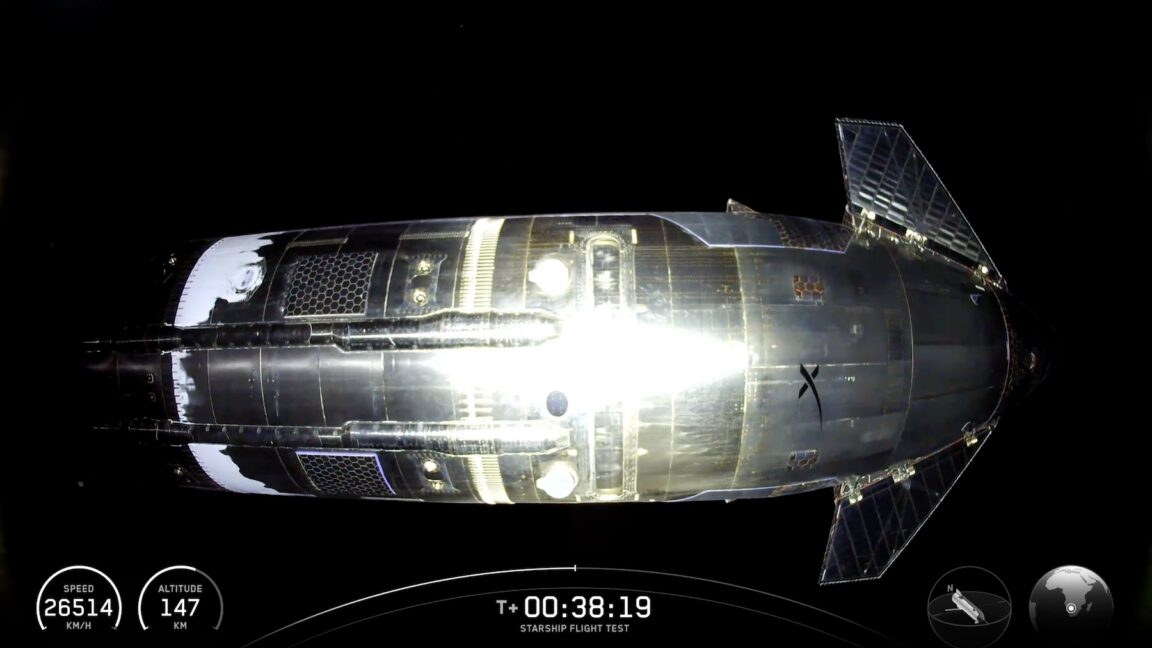
SpaceX just launched its upgraded Starship V3, complete with the Super Heavy booster, on its first test flight. Mostly good news, folks. This mission? A pretty big deal for SpaceX, especially as they try to get Starship ready for those tricky human-rated lunar landings.
Liftoff!
That 408-foot-tall rocket, the biggest ever built, blasted off from SpaceX’s Starbase down in South Texas. Clocked it at 5:30 pm CDT. Cleared the tower in seconds, then shot east over the Gulf of Mexico. An hour later, give or take, it hit the Indian Ocean for splashdown. Mission accomplished.
Remember V1 and V2? They broke apart in 2023 and 2025. Not great. But Starship V3? It showed real improvements. A lot of improvements, actually. Elon Musk, SpaceX's founder, and his team? They looked pretty happy. Called it a solid step toward making space travel routine. And why not?
What's New? Big Capacity.
Starship V3 just doubled its payload capacity. We're talking 100 metric tons into low-Earth orbit now. That's a huge leap. To put this in perspective, NASA's Saturn V, the legendary moon rocket, could carry up to 140 metric tons to low Earth orbit. Starship V3 is inching closer to that with its own monumental capabilities.
Part of that comes from a new deployment system, tweaked specifically for SpaceX's own Starlink satellites. During the test, it successfully deployed 20 Starlink satellite mockups. Plus, two inspection spacecraft to check out Starship’s exterior. These inspection spacecraft are pivotal for future missions as they provide real-time diagnostics on the spacecraft's structure and performance.
The spacecraft hit a peak altitude of 121 miles (195 kilometers) over the South Atlantic. And get this: the heat shield and aerodynamic flaps stayed intact through reentry. A critical win after previous flights. These components are crucial for ensuring the spacecraft can withstand the intense heat and pressure of re-entering Earth's atmosphere, a major hurdle for reusable spacecraft technology.
Not Perfect, But Better
Okay, so it wasn't flawless. Two Raptor engines failed during launch – one on the Super Heavy booster, another on Starship itself. These were the first Raptor 3 engines, by the way. Lighter, more efficient. Still, a hiccup.
But Starship proved it could handle engine-out scenarios. Again. The rocket just kept going. This capability is essential for ensuring the rocket can complete its mission even if some engines fail, enhancing reliability and safety.
And the new launch pad at Starbase? It held up, even under those intense launch conditions. Good news for future launches from Cape Canaveral, Florida. Those new pads are waiting. The durability of the launch infrastructure is key to maintaining a high launch cadence, a goal SpaceX is aggressively pursuing.
Global Impact?
SpaceX's V3 advancements aren't just for them. The global space industry is watching. Hard. The European Space Agency (ESA) is paying close attention. This could totally shift European launch strategies, maybe even future collaborations. More payload capacity, more reliability from SpaceX? That's going to influence satellite deployment and space exploration missions worldwide.
Imagine a world where launching multiple satellites for communications, weather monitoring, and scientific research becomes as routine as commercial airline flights. With the cost of launches potentially decreasing as capacity increases, more organizations, including smaller startups and universities, could afford to send payloads to space.
Why You Should Care
For anyone into space, or in the industry, Starship V3’s successful flight means a big jump in how much stuff we can send up, and how easily. Think more frequent, cheaper satellite launches. That's a game-changer for global communications and space research. So yeah, keep an eye on SpaceX. They're refining this tech, fast.
If you're someone who relies on satellite services, from GPS navigation to satellite internet, this development could mean better service and lower costs in the future. Businesses and consumers alike stand to benefit from the increased efficiency and accessibility of space-based services.
Still Some Questions
Those Raptor 3 engine failures? We don't know yet how SpaceX plans to fix them, or when the next test flight will happen. And the timeline for Starship to actually carry humans for NASA's lunar missions? Still up in the air.
The Raptor 3 engine is a critical component of SpaceX's plans, and understanding its limitations and resolving issues will be key to achieving the ambitious goals set by the company. SpaceX's iterative approach means that each test flight provides valuable data for improvements.
The Bottom Line
"SpaceX's Starship V3 doubles down on capacity and innovation." That's the quote. With its enhanced capabilities and a mostly successful flight, Starship V3 could honestly revolutionize space logistics. It doesn't just solidify SpaceX's spot in aerospace; it truly sets the stage for a new era of space exploration. Big stuff.
SpaceX's developments continue to push the boundaries of what’s possible, reminding us that the vision of making space travel commonplace is steadily becoming reality. Whether it's the excitement of future manned missions to Mars or the routine deployment of satellites that change how we communicate and understand the world, Starship V3 is a pivotal piece of the puzzle. As with any pioneering technology, there are hurdles to overcome, but the path forward is bright with promise and potential.
Discuss this story
Got a take, a correction, or a follow-up tip? Reply where you read — we read everything.
Found an error? File a correction at /corrections. Substantive corrections are logged publicly.
One short email. The most important Science news, fact-checked, no fluff. Free, unsubscribe anytime.
More from Science
Quantum Computing Explained for Developers: A 2026 Update
Explore quantum computing fundamentals, hardware, and how it impacts software development in this comprehensive guide for developers.

Quantum Computing Advances: Key Updates from Microsoft, Atom, and EeroQ
Microsoft, Atom Computing, and EeroQ share key updates in their quantum computing efforts, marking steady progress toward practical applications.

Star City Explores the Human Cost Behind the Soviet Space Program
Forget Mars colonies. Star City, the new spin-off from For All Mankind, dives deep into the gritty, dangerous, and often ethically complex world of the Soviet space program in the late 1960s.
A Gritty, High-Stakes Drama: Exploring the Soviet Space Program in Star City
Explore the untold story of the Soviet space program in Star City, a new Apple TV+ series that swaps the familiar American perspective for a gritty, high-stakes drama centered on its visionary, yet constrained, leadership.
The Byte-Pulse Newsroom is the editorial system that produces Byte-Pulse's daily tech news coverage. Each story is cross-referenced across 3+ independent outlets, drafted with AI assistance by the newsroom system (Drafter → Editor → Fact-Checker → Polisher), and reviewed by Serhat Er, Editor-in-Chief, before publication. We disclose AI augmentation openly. Editorial accountability stays with the named editor on every article. Tips: editorial@byte-pulse.net.
Don’t miss these
Asus ROG Phone 9 vs Sony Xperia 1 VII: Which Niche Flagship Earns Your Money?
Deciding between the gaming-focused ROG Phone 9 and the creator-centric Xperia 1 VII? This guide breaks down every spec to help you choose.
Proton VPN vs NordVPN: Which One Earns Your Subscription?
A deep dive into Proton VPN and NordVPN, comparing their privacy, performance, features, and value, helping you make an informed decision.
Perplexity Pro vs ChatGPT Plus: Which AI Assistant Fits Your Workflow?
This guide lays out the strengths and approaches of Perplexity Pro and ChatGPT Plus, helping you identify which AI assistant aligns with your specific needs.

Pokémon TCG Movie Signals Strategic Media Pivot for The Pokémon Company
A new Pokémon movie focused on the TCG is coming in 2027, marking a strategic pivot for the franchise as it navigates massive global fan engagement and logistical challenges.

Apple's AI Pivot: Vision Pro Content Cut, Siri Rebuilt Amid Layoffs
Apple's latest layoffs signal a strategic pivot, dialing back high-cost Vision Pro content while re-tooling Siri for the AI era. What's next for Apple?
Honor Magic 8 Pro vs Samsung Galaxy S26 Ultra: Which Future Flagship Fits Your Wallet and Workflow?
Deciding between the anticipated Honor Magic 8 Pro and Samsung Galaxy S26 Ultra? Our deep dive into expected specs and features provides the fair comparison you need.