Intel Xeon 6+ Launches June 1: A New Era for Hyperscalers
New E-core processors target hyperscalers with improved performance-per-watt and advanced telemetry, challenging AMD's Turin.

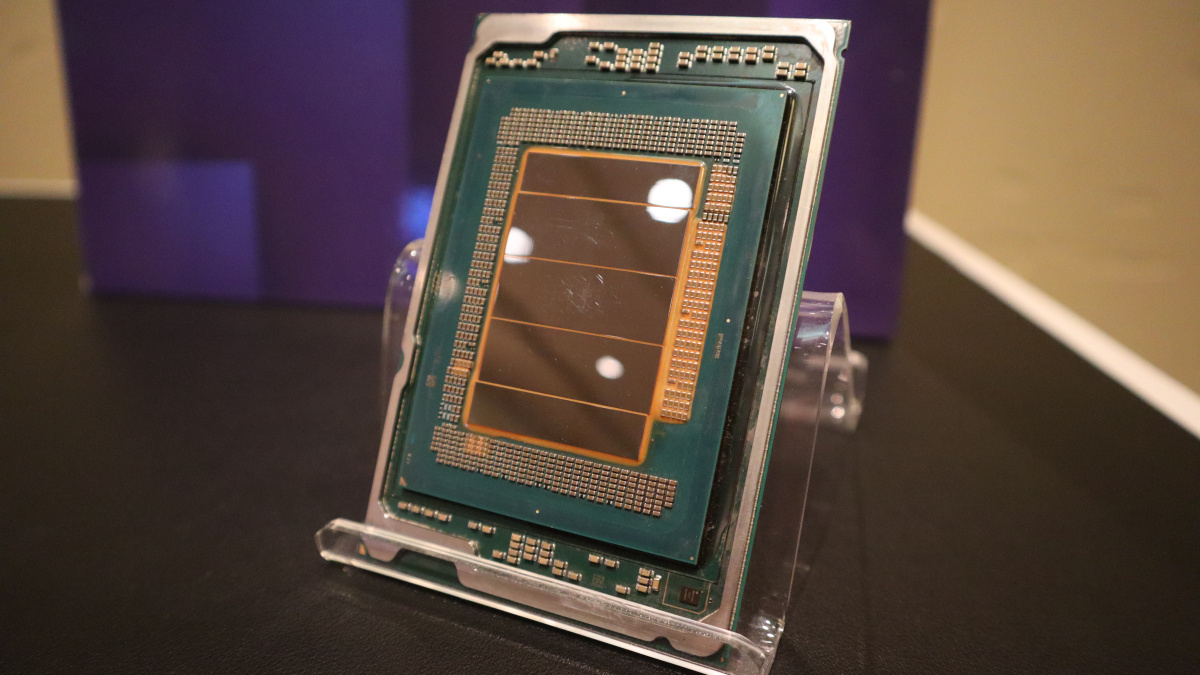
Intel is officially launching its Clearwater Forest processors, now branded as Xeon 6+, on June 1, 2026. This new line of E-core processors is designed to tackle the demands of hyperscalers and large data centers, offering configurations with up to 288 cores per server. The company is positioning these chips as a significant step forward in performance and efficiency, directly challenging AMD's Epyc Turin processors.
A Hybrid Approach to Chiplet Design
The Xeon 6+ processors leverage Intel's advanced manufacturing processes, combining chiplets produced on Intel 18A with those made on Intel 3. This hybrid approach sees the CPU core chiplets manufactured on Intel 18A, while the base dies containing memory controllers, Network-on-Chip (NoC), and L3 cache are built using Intel 3. Complementing these are I/O chiplets fabricated on Intel 7, which bring accelerators for various application scenarios. Notably, the Xeon 6+ can also accelerate SHA-512 and the Chinese encryption standards SM3 and SM4.
Performance and Efficiency Claims
Intel is touting substantial improvements with the Xeon 6+ series. The company claims an average of 30 percent more performance per thread compared to AMD's Zen 5c-based Epyc Turin processors. Furthermore, Intel expects a 55 percent uplift in performance per watt when compared to its predecessor, Sierra Forest. While the efficiency advantage over Turin might be less pronounced, Intel anticipates the Clearwater Forest will deliver up to 30 percent higher performance per watt, particularly under medium load conditions.
Advanced Telemetry for Deeper Insights
A key innovation with the Xeon 6+ is the introduction of Application Energy Telemetry (AET). This feature promises to provide power consumption data at the granularity of individual cores. Integrated into Linux kernel 7.0, AET aims to enable more precise estimation of energy usage for specific applications or even threads. This enhanced visibility is expected to simplify application orchestration and facilitate optimization efforts within data centers.
"With Application Energy Telemetry (AET), power consumption can be measured with the granularity of individual cores."
Model Lineup and Platform Integration
The Xeon 6+ lineup, while not excessively large, focuses on high-density compute. The processors utilize the same platform as Granite Rapids, Intel's P-core Xeons, ensuring compatibility. Intel is offering the two largest models, the Xeon 6 990E+ and 980E+, in two Thermal Design Power (TDP) variants each, catering to different cooling and power constraints. Memory support includes twelve memory controllers capable of up to 8,000 MT/s with MRDIMMs. For multi-socket systems, six UPI links are available, and the platform provides 96 PCIe 5.0 lanes for device connectivity.
"Intel expects the Clearwater Forest to deliver up to 30 percent higher performance per watt, particularly under medium load conditions."
Intel is also introducing new Ethernet controllers, such as the E835, which offer bandwidths from 25 to 200 GBit/s. These adapters support RoCEv2 and can offload packet processing tasks from the CPU, further enhancing efficiency. Support for Synchronous Ethernet and Precision Time Protocol is also highlighted.
Context:
Intel's strategy with the Xeon 6+ highlights a continued push towards specialized silicon and heterogeneous computing, a trend seen across the industry. By combining different manufacturing nodes and chiplet designs, Intel aims to optimize cost and performance. This approach mirrors advancements seen in the ARM ecosystem and custom silicon development, where flexibility and tailored performance are paramount for cloud providers and hyperscalers. The focus on power efficiency is also critical as data centers grapple with rising energy costs and environmental concerns, particularly in Europe where sustainability regulations are increasingly stringent.
What this means for you:
For IT professionals and data center operators, the Xeon 6+ launch signals a new generation of processors that could lead to more efficient and powerful server deployments. If Intel's performance-per-watt claims hold true, organizations might see reduced energy costs and a smaller physical footprint for their compute infrastructure. The enhanced telemetry could also lead to better application performance tuning. Keep an eye on pricing and availability as these processors enter the market.
What's still unclear:
While Intel has provided a roadmap and performance projections, specific real-world benchmarks comparing the Xeon 6+ directly against AMD's Turin across a wide range of workloads are still needed. The exact pricing structure for the various Xeon 6+ models has not yet been detailed. Furthermore, the long-term reliability and adoption rate of the new AET feature within the broader software ecosystem remain to be seen.
Why this matters:
The Xeon 6+ launch is Intel's latest attempt to regain market share in the critical server CPU segment by focusing on efficiency and core density. Its success will be a key indicator of Intel's ability to compete with rivals like AMD and ARM-based solutions in the high-margin data center market.
Discuss this story
Got a take, a correction, or a follow-up tip? Reply where you read — we read everything.
Found an error? File a correction at /corrections. Substantive corrections are logged publicly.
One short email. The most important Hardware news, fact-checked, no fluff. Free, unsubscribe anytime.
More from Hardware
RTX 5060 Ti vs RX 9060 XT: Which Mid-Range Powerhouse Fits Your Rig?
Deciding between the rumored RTX 5060 Ti and RX 9060 XT? This guide cuts through the noise to highlight the real-world trade-offs for gamers and creators.
Lenovo Legion Pro 7i 2026 vs Razer Blade 16 2026: Which Flagship Gaming Laptop Fits Your Future?
Deciding between the next-gen Lenovo Legion Pro 7i and Razer Blade 16 means weighing peak performance against premium design and a more compact footprint. We break down the trade-offs.
Razer Blade 16 (2026) vs ASUS ROG Zephyrus G16 (2026): Which Next-Gen Powerhouse Fits Your Workflow?
Deciding between Razer's premium Blade 16 2026 and ASUS's versatile ROG Zephyrus G16? We cut through the hype to lay out the real trade-offs.
HP Spectre x360 2026 vs MacBook Air M5: Which Flagship Laptop Fits Your Future?
Deciding between the versatile HP Spectre x360 2026 and the efficient MacBook Air M5 means weighing form factor, operating system, and core priorities.
The Byte-Pulse Newsroom is the editorial system that produces Byte-Pulse's daily tech news coverage. Each story is cross-referenced across 3+ independent outlets, drafted with AI assistance by the newsroom system (Drafter → Editor → Fact-Checker → Polisher), and reviewed by Serhat Er, Editor-in-Chief, before publication. We disclose AI augmentation openly. Editorial accountability stays with the named editor on every article. Tips: editorial@byte-pulse.net.
Don’t miss these
Asus ROG Phone 9 vs Sony Xperia 1 VII: Which Niche Flagship Earns Your Money?
Deciding between the gaming-focused ROG Phone 9 and the creator-centric Xperia 1 VII? This guide breaks down every spec to help you choose.
Proton VPN vs NordVPN: Which One Earns Your Subscription?
A deep dive into Proton VPN and NordVPN, comparing their privacy, performance, features, and value, helping you make an informed decision.
Perplexity Pro vs ChatGPT Plus: Which AI Assistant Fits Your Workflow?
This guide lays out the strengths and approaches of Perplexity Pro and ChatGPT Plus, helping you identify which AI assistant aligns with your specific needs.

Pokémon TCG Movie Signals Strategic Media Pivot for The Pokémon Company
A new Pokémon movie focused on the TCG is coming in 2027, marking a strategic pivot for the franchise as it navigates massive global fan engagement and logistical challenges.
Honor Magic 8 Pro vs Samsung Galaxy S26 Ultra: Which Future Flagship Fits Your Wallet and Workflow?
Deciding between the anticipated Honor Magic 8 Pro and Samsung Galaxy S26 Ultra? Our deep dive into expected specs and features provides the fair comparison you need.
Notion vs Obsidian: Which Knowledge Hub Fits Your Workflow?
Deciding between Notion and Obsidian? We break down the core differences in philosophy, data ownership, collaboration, and extensibility to help you choose.